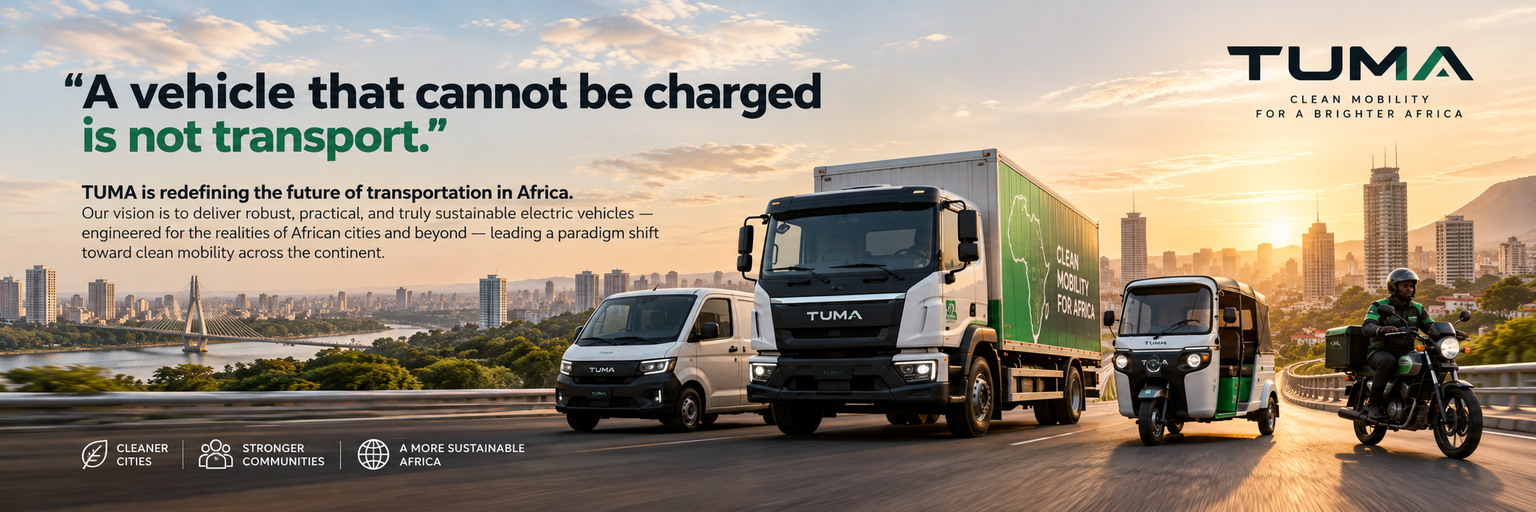
"A vehicle that cannot be charged is not transport."
TUMA is redefining the future of transportation in Africa. Our vision is to deliver robust, practical, and truly sustainable electric vehicles — engineered for the realities of African cities and beyond — leading a paradigm shift toward clean mobility across the continent.
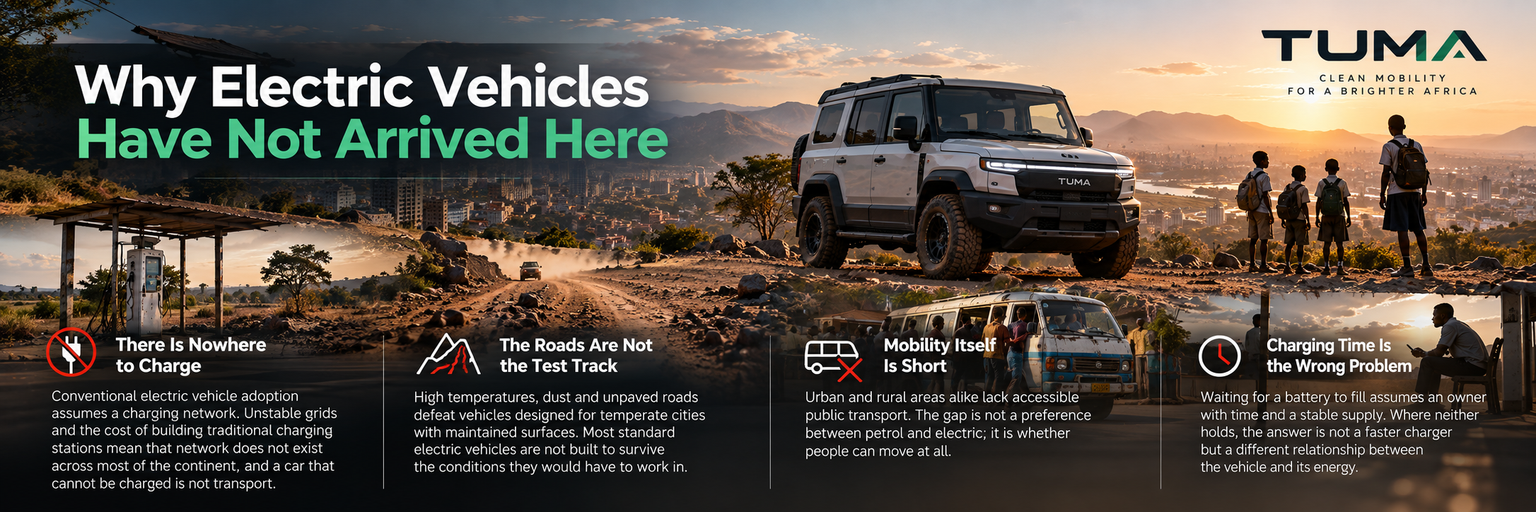
Conventional electric vehicle adoption assumes a charging network. Unstable grids and the cost of building traditional charging stations mean that network does not exist across most of the continent, and a car that cannot be charged is not transport.
High temperatures, dust and unpaved roads defeat vehicles designed for temperate cities with maintained surfaces. Most standard electric vehicles are not built to survive the conditions they would have to work in.
Urban and rural areas alike lack accessible public transport. The gap is not a preference between petrol and electric; it is whether people can move at all.
Waiting for a battery to fill assumes an owner with time and a stable supply. Where neither holds, the answer is not a faster charger but a different relationship between the vehicle and its energy.
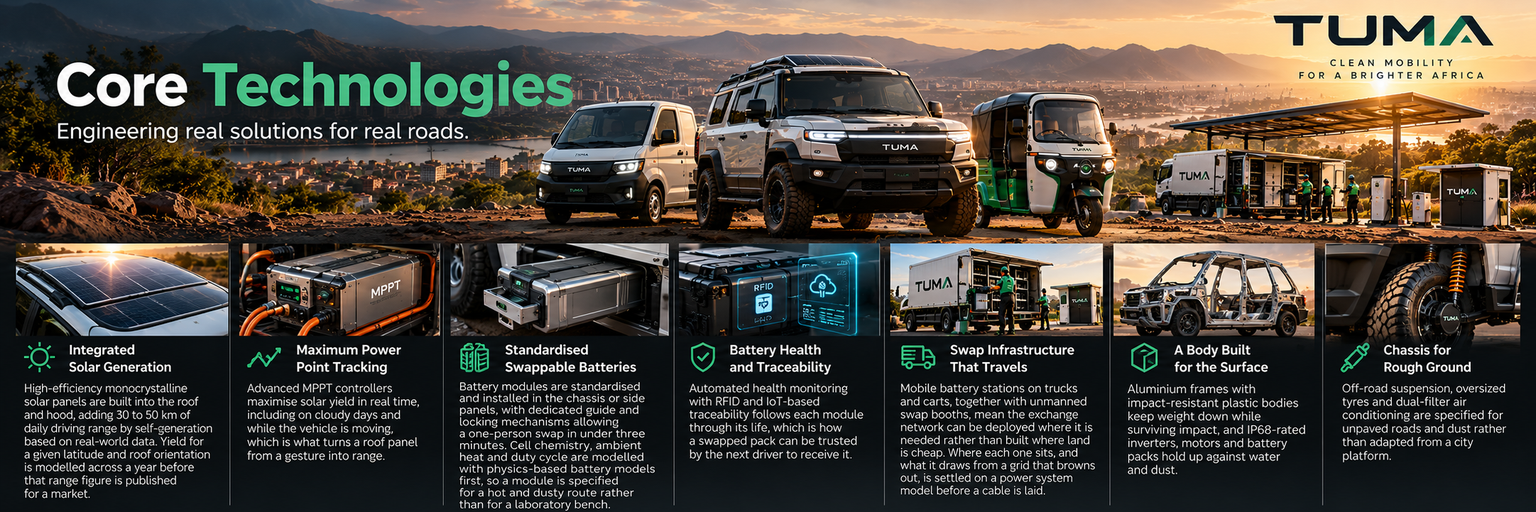
High-efficiency monocrystalline solar panels are built into the roof and hood, adding 30 to 50 km of daily driving range by self-generation based on real-world data. Yield for a given latitude and roof orientation is modelled across a year before that range figure is published for a market.
Advanced MPPT controllers maximise solar yield in real time, including on cloudy days and while the vehicle is moving, which is what turns a roof panel from a gesture into range.
Battery modules are standardised and installed in the chassis or side panels, with dedicated guide and locking mechanisms allowing a one-person swap in under three minutes. Cell chemistry, ambient heat and duty cycle are modelled with physics-based battery models first, so a module is specified for a hot and dusty route rather than for a laboratory bench.
Automated health monitoring with RFID and IoT-based traceability follows each module through its life, which is how a swapped pack can be trusted by the next driver to receive it.
Mobile battery stations on trucks and carts, together with unmanned swap booths, mean the exchange network can be deployed where it is needed rather than built where land is cheap. Where each one sits, and what it draws from a grid that browns out, is settled on a power system model before a cable is laid.
Aluminium frames with impact-resistant plastic bodies keep weight down while surviving impact, and IP68-rated inverters, motors and battery packs hold up against water and dust.
Off-road suspension, oversized tyres and dual-filter air conditioning are specified for unpaved roads and dust rather than adapted from a city platform.
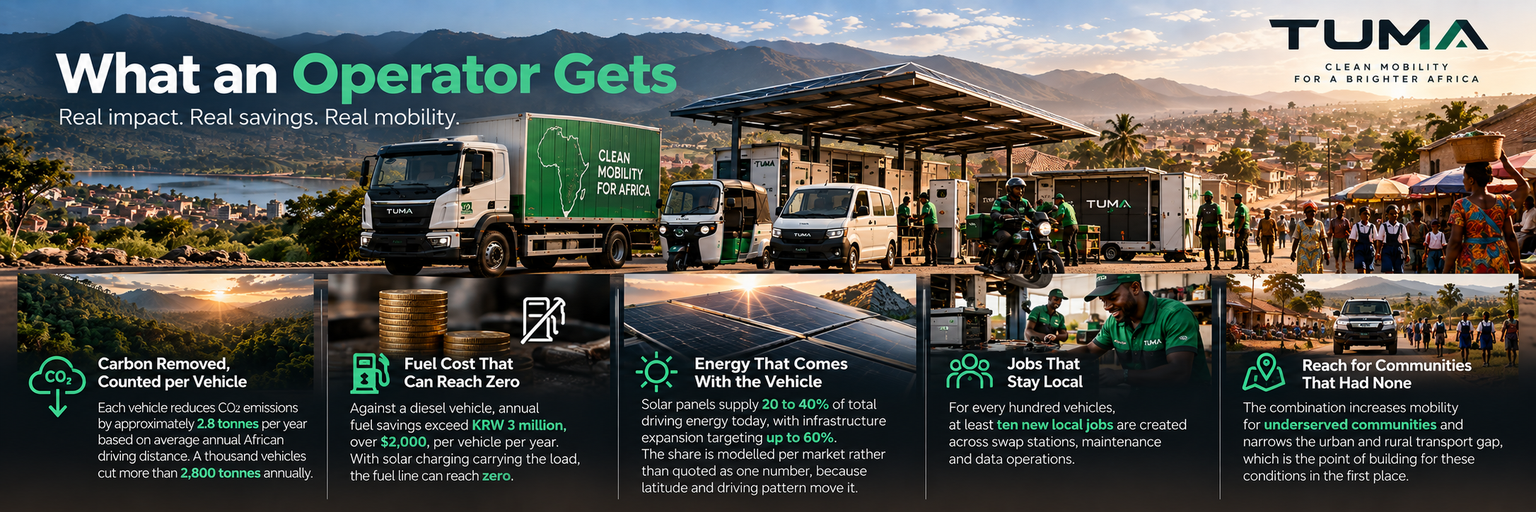
Each vehicle reduces CO2 emissions by approximately 2.8 tonnes per year based on average annual African driving distance. A thousand vehicles cut more than 2,800 tonnes annually.
Against a diesel vehicle, annual fuel savings exceed KRW 3 million, over $2,000, per vehicle per year. With solar charging carrying the load, the fuel line can reach zero.
Solar panels supply 20 to 40% of total driving energy today, with infrastructure expansion targeting up to 60%. The share is modelled per market rather than quoted as one number, because latitude and driving pattern move it.
For every hundred vehicles, at least ten new local jobs are created across swap stations, maintenance and data operations.
The combination increases mobility for underserved communities and narrows the urban and rural transport gap, which is the point of building for these conditions in the first place.
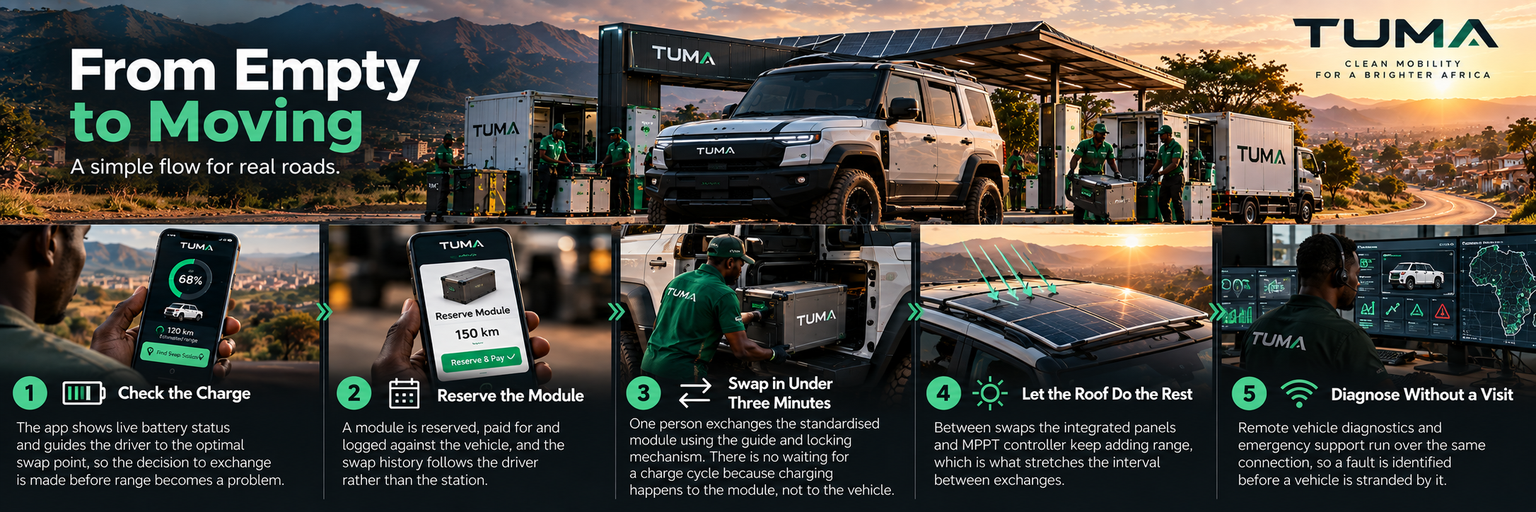
The app shows live battery status and guides the driver to the optimal swap point, so the decision to exchange is made before range becomes a problem.
A module is reserved, paid for and logged against the vehicle, and the swap history follows the driver rather than the station.
One person exchanges the standardised module using the guide and locking mechanism. There is no waiting for a charge cycle because charging happens to the module, not to the vehicle.
Between swaps the integrated panels and MPPT controller keep adding range, which is what stretches the interval between exchanges.
Remote vehicle diagnostics and emergency support run over the same connection, so a fault is identified before a vehicle is stranded by it.
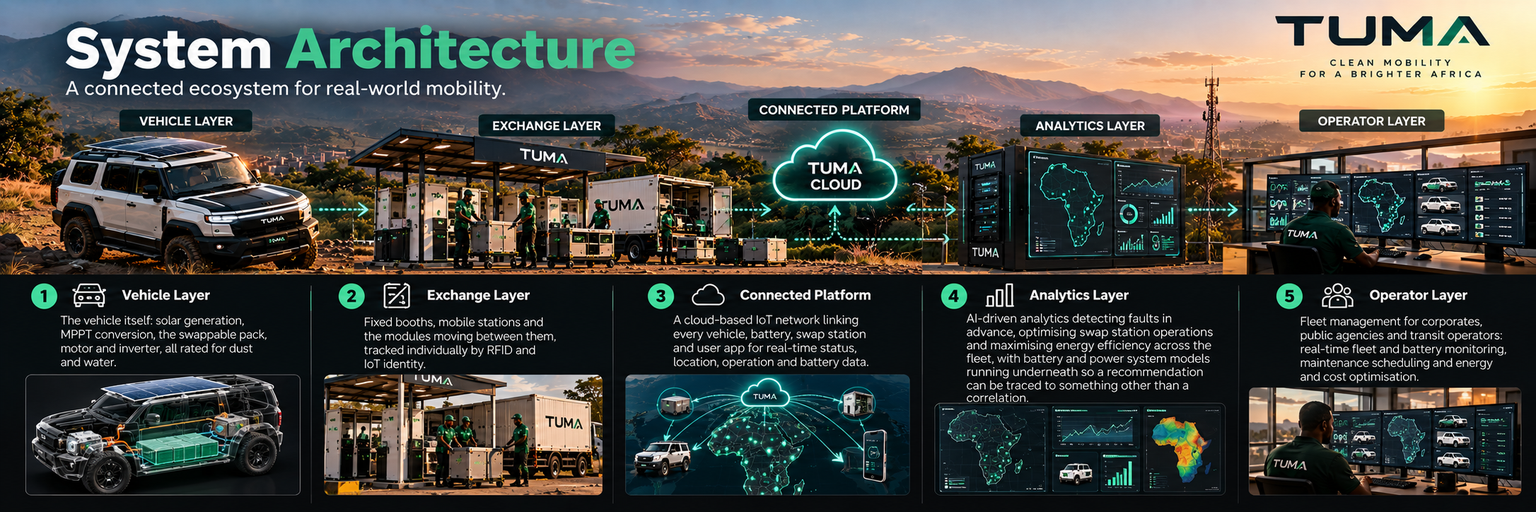
The vehicle itself: solar generation, MPPT conversion, the swappable pack, motor and inverter, all rated for dust and water.
Fixed booths, mobile stations and the modules moving between them, tracked individually by RFID and IoT identity.
A cloud-based IoT network linking every vehicle, battery, swap station and user app for real-time status, location, operation and battery data.
AI-driven analytics detecting faults in advance, optimising swap station operations and maximising energy efficiency across the fleet, with battery and power system models running underneath so a recommendation can be traced to something other than a correlation.
Fleet management for corporates, public agencies and transit operators: real-time fleet and battery monitoring, maintenance scheduling and energy and cost optimisation.
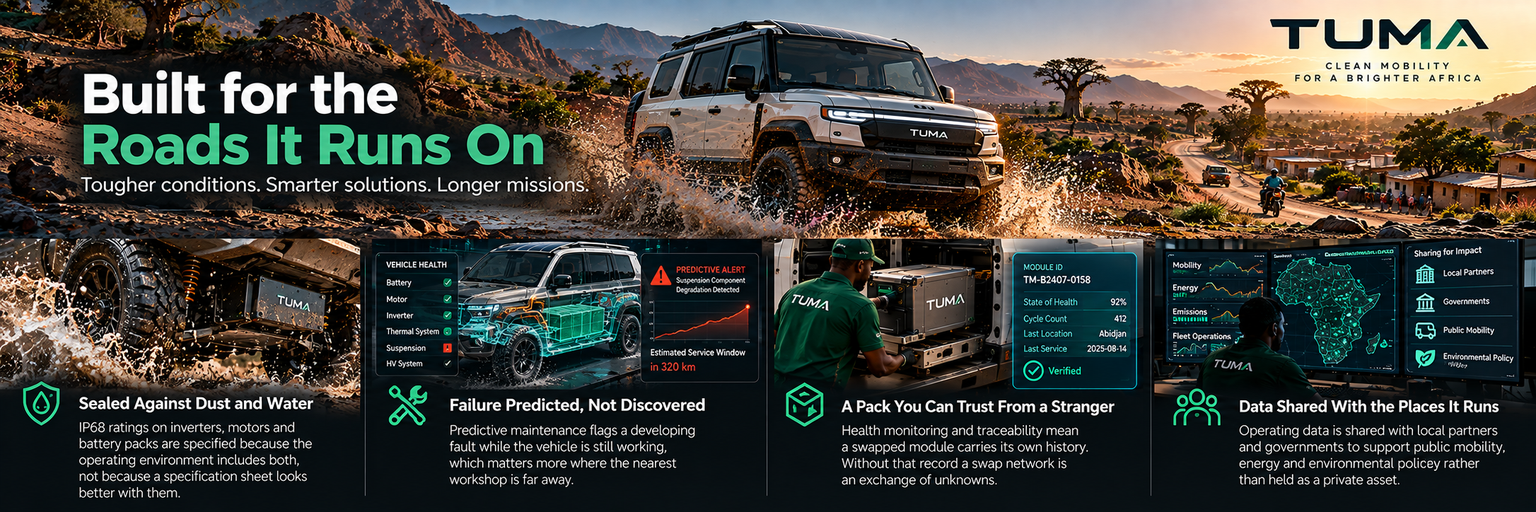
IP68 ratings on inverters, motors and battery packs are specified because the operating environment includes both, not because a specification sheet looks better with them.
Predictive maintenance flags a developing fault while the vehicle is still working, which matters more where the nearest workshop is far away.
Health monitoring and traceability mean a swapped module carries its own history. Without that record a swap network is an exchange of unknowns.
Operating data is shared with local partners and governments to support public mobility, energy and environmental policy rather than held as a private asset.
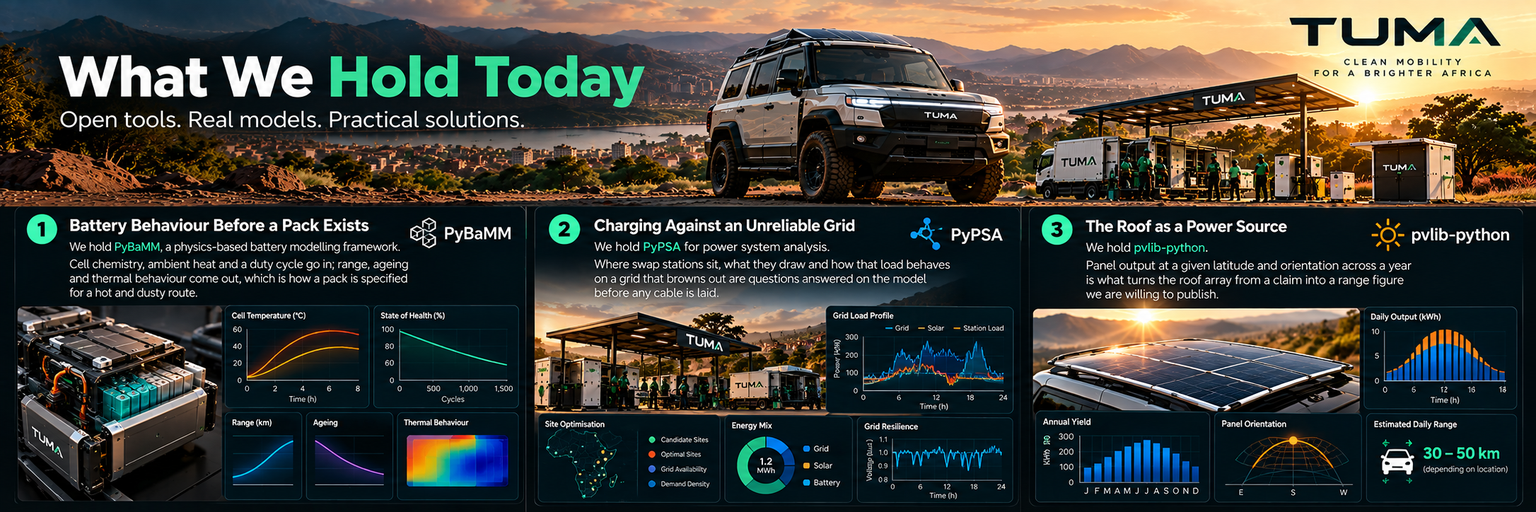
We hold PyBaMM, a physics-based battery modelling framework. Cell chemistry, ambient heat and a duty cycle go in; range, ageing and thermal behaviour come out, which is how a pack is specified for a hot and dusty route.
We hold PyPSA for power system analysis. Where swap stations sit, what they draw and how that load behaves on a grid that browns out are questions answered on the model before any cable is laid.
We hold pvlib-python. Panel output at a given latitude and orientation across a year is what turns the roof array from a claim into a range figure we are willing to publish.
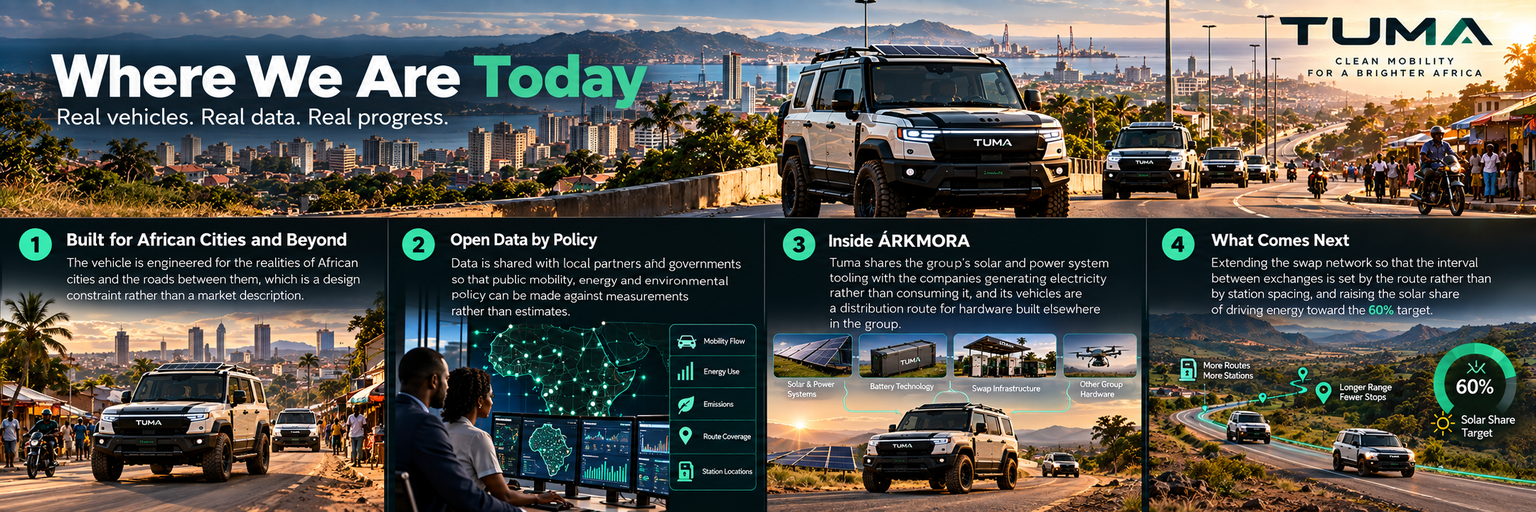
The vehicle is engineered for the realities of African cities and the roads between them, which is a design constraint rather than a market description.
Data is shared with local partners and governments so that public mobility, energy and environmental policy can be made against measurements rather than estimates.
Tuma shares the group's solar and power system tooling with the companies generating electricity rather than consuming it, and its vehicles are a distribution route for hardware built elsewhere in the group.
Extending the swap network so that the interval between exchanges is set by the route rather than by station spacing, and raising the solar share of driving energy toward the 60% target.
"Africa does not need to follow the combustion path. It leads the world into a clean, electric, solar-powered future."
TUMA — Redefining Transportation for Africa.