
"An ingredient should be able to explain itself."
Most skincare is sold on where an ingredient came from. Sionéth is built the other way around: the active at the centre of a product is designed against a stated target, folded and checked computationally, and only then given a carrier and a formulation.
The work began in 2022 as K-HAN, a prototype line built on Chaga mushroom extract and fermented seaweed extract from Jeju Island, and three years of user feedback from across the globe sit behind what follows. The relaunch under the Sionéth name is scheduled for the first half of 2027.
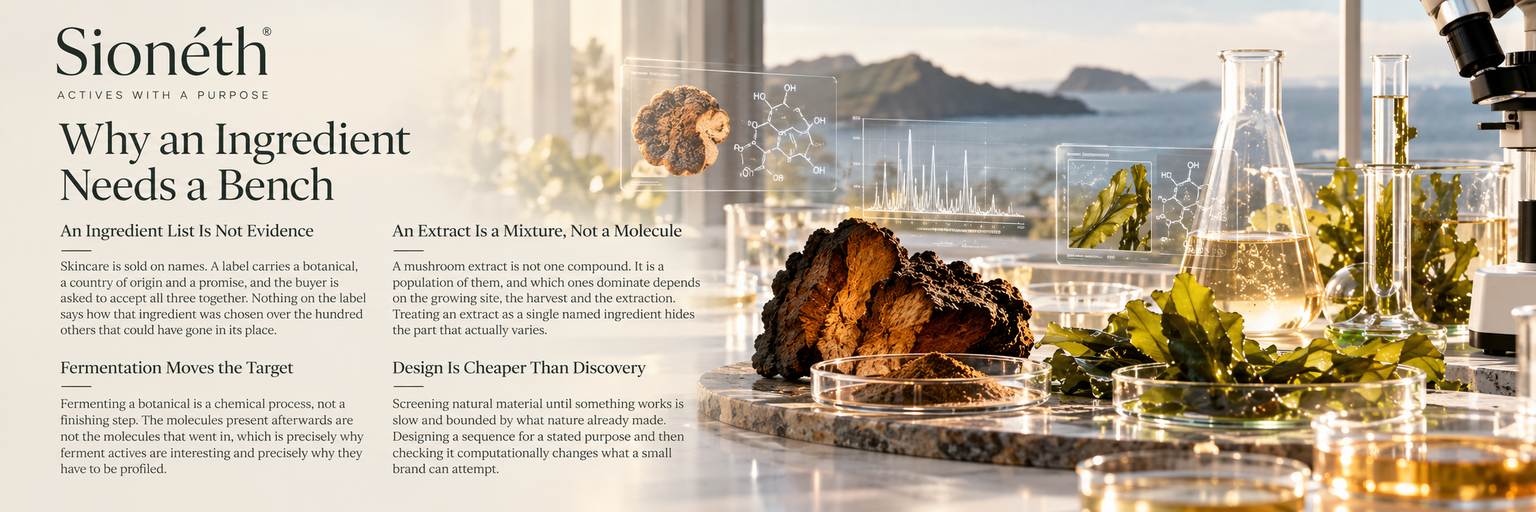
Skincare is sold on names. A label carries a botanical, a country of origin and a promise, and the buyer is asked to accept all three together. Nothing on the label says how that ingredient was chosen over the hundred others that could have gone in its place.
A mushroom extract is not one compound. It is a population of them, and which ones dominate depends on the growing site, the harvest and the extraction. Treating an extract as a single named ingredient hides the part that actually varies.
Fermenting a botanical is a chemical process, not a finishing step. The molecules present afterwards are not the molecules that went in, which is precisely why ferment actives are interesting and precisely why they have to be profiled.
Screening natural material until something works is slow and bounded by what nature already made. Designing a sequence for a stated purpose and then checking it computationally changes what a small brand can attempt.
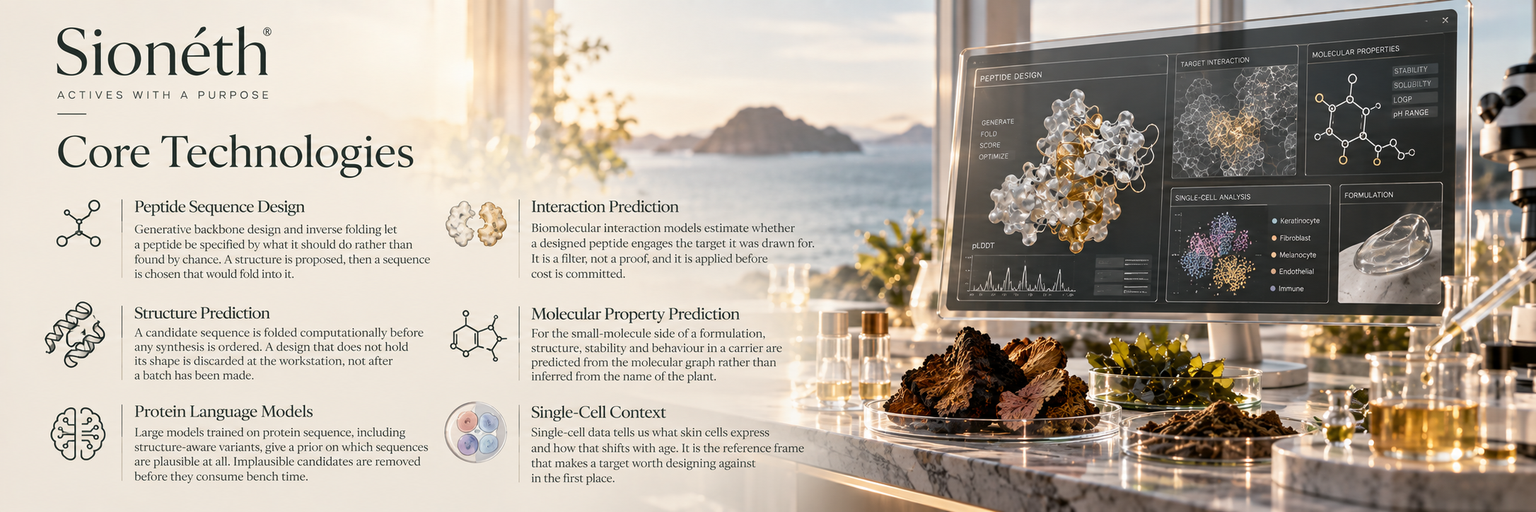
Generative backbone design and inverse folding let a peptide be specified by what it should do rather than found by chance. A structure is proposed, then a sequence is chosen that would fold into it.
A candidate sequence is folded computationally before any synthesis is ordered. A design that does not hold its shape is discarded at the workstation, not after a batch has been made.
Large models trained on protein sequence, including structure-aware variants, give a prior on which sequences are plausible at all. Implausible candidates are removed before they consume bench time.
Biomolecular interaction models estimate whether a designed peptide engages the target it was drawn for. It is a filter, not a proof, and it is applied before cost is committed.
For the small-molecule side of a formulation, structure, stability and behaviour in a carrier are predicted from the molecular graph rather than inferred from the name of the plant.
Single-cell data tells us what skin cells express and how that shifts with age. It is the reference frame that makes a target worth designing against in the first place.
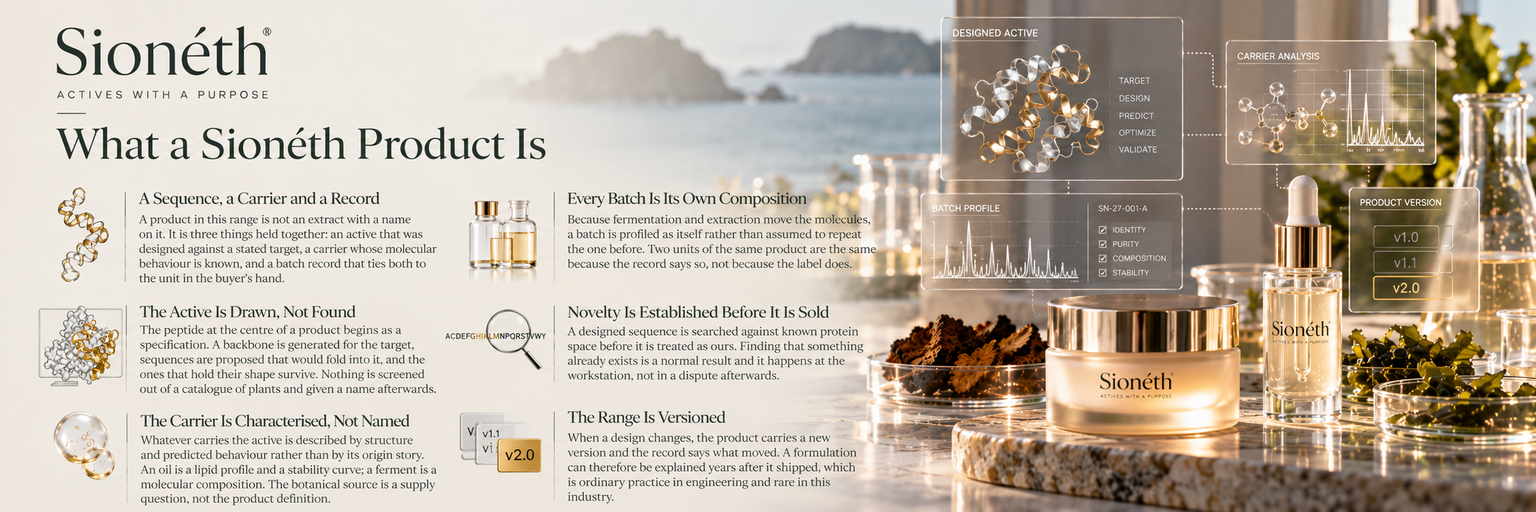
A product in this range is not an extract with a name on it. It is three things held together: an active that was designed against a stated target, a carrier whose molecular behaviour is known, and a batch record that ties both to the unit in the buyer's hand.
The peptide at the centre of a product begins as a specification. A backbone is generated for the target, sequences are proposed that would fold into it, and the ones that hold their shape survive. Nothing is screened out of a catalogue of plants and given a name afterwards.
Whatever carries the active is described by structure and predicted behaviour rather than by its origin story. An oil is a lipid profile and a stability curve; a ferment is a molecular composition. The botanical source is a supply question, not the product definition.
Because fermentation and extraction move the molecules, a batch is profiled as itself rather than assumed to repeat the one before. Two units of the same product are the same because the record says so, not because the label does.
A designed sequence is searched against known protein space before it is treated as ours. Finding that something already exists is a normal result and it happens at the workstation, not in a dispute afterwards.
When a design changes, the product carries a new version and the record says what moved. A formulation can therefore be explained years after it shipped, which is ordinary practice in engineering and rare in this industry.
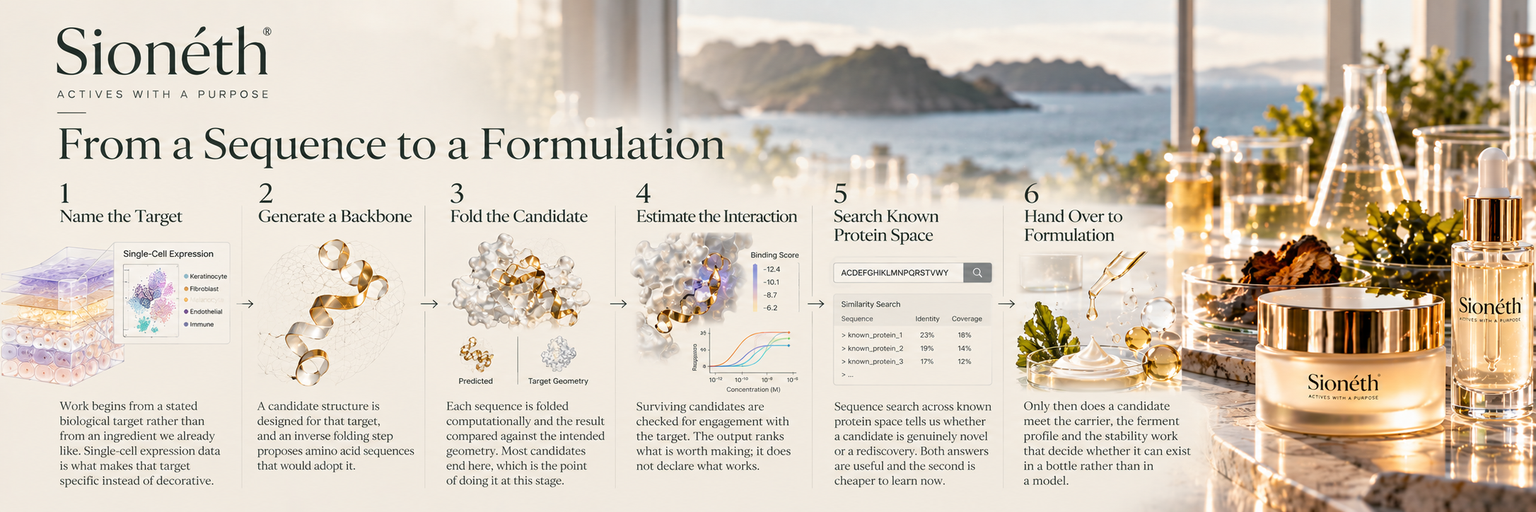
Work begins from a stated biological target rather than from an ingredient we already like. Single-cell expression data is what makes that target specific instead of decorative.
A candidate structure is designed for that target, and an inverse folding step proposes amino acid sequences that would adopt it.
Each sequence is folded computationally and the result compared against the intended geometry. Most candidates end here, which is the point of doing it at this stage.
Surviving candidates are checked for engagement with the target. The output ranks what is worth making; it does not declare what works.
Sequence search across known protein space tells us whether a candidate is genuinely novel or a rediscovery. Both answers are useful and the second is cheaper to learn now.
Only then does a candidate meet the carrier, the ferment profile and the stability work that decide whether it can exist in a bottle rather than in a model.
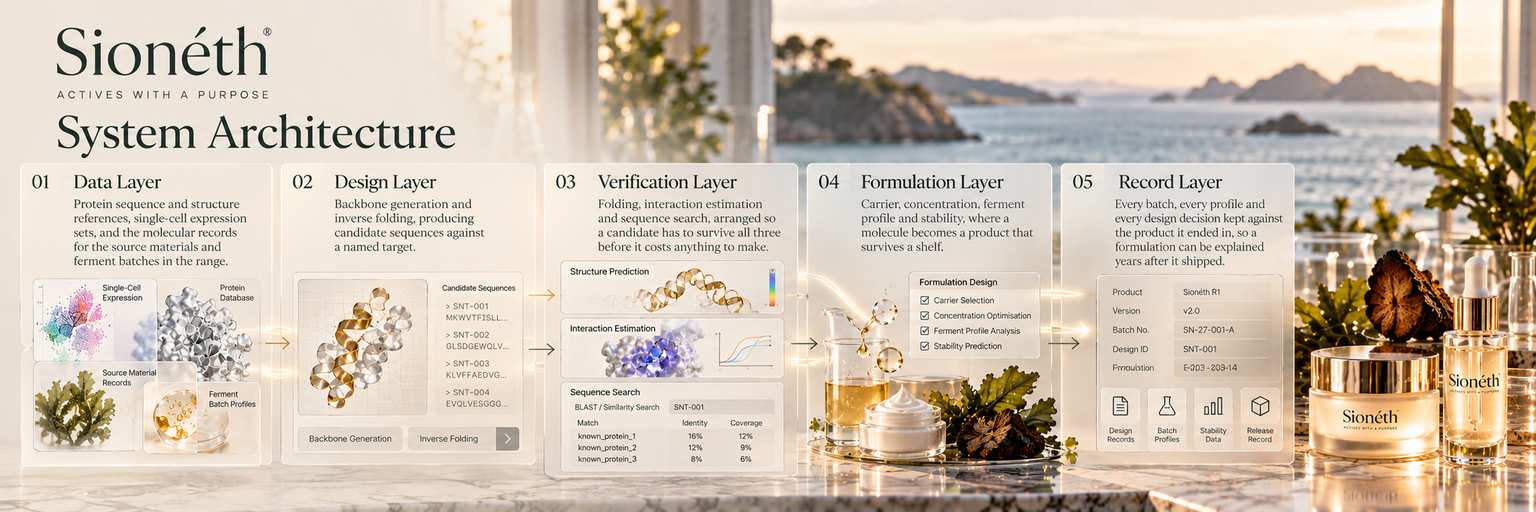
Protein sequence and structure references, single-cell expression sets, and the molecular records for the source materials and ferment batches in the range.
Backbone generation and inverse folding, producing candidate sequences against a named target.
Folding, interaction estimation and sequence search, arranged so a candidate has to survive all three before it costs anything to make.
Carrier, concentration, ferment profile and stability, where a molecule becomes a product that survives a shelf.
Every batch, every profile and every design decision kept against the product it ended in, so a formulation can be explained years after it shipped.
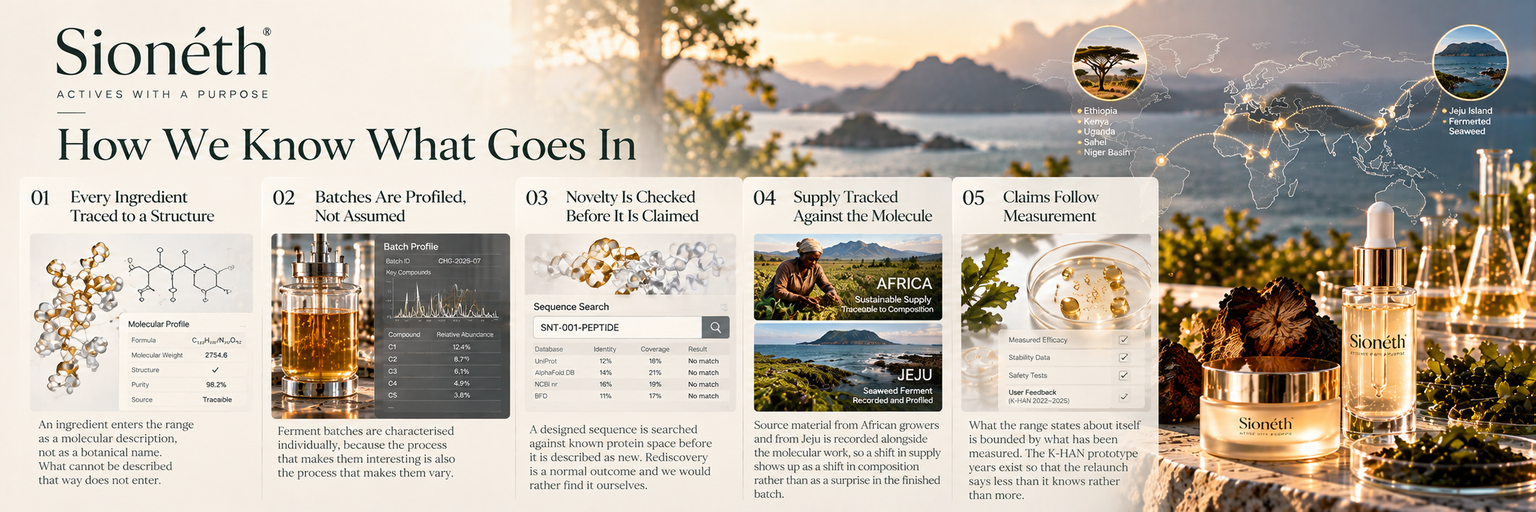
An ingredient enters the range as a molecular description, not as a botanical name. What cannot be described that way does not enter.
Ferment batches are characterised individually, because the process that makes them interesting is also the process that makes them vary.
A designed sequence is searched against known protein space before it is described as new. Rediscovery is a normal outcome and we would rather find it ourselves.
Source material from African growers and from Jeju is recorded alongside the molecular work, so a shift in supply shows up as a shift in composition rather than as a surprise in the finished batch.
What the range states about itself is bounded by what has been measured. The K-HAN prototype years exist so that the relaunch says less than it knows rather than more.
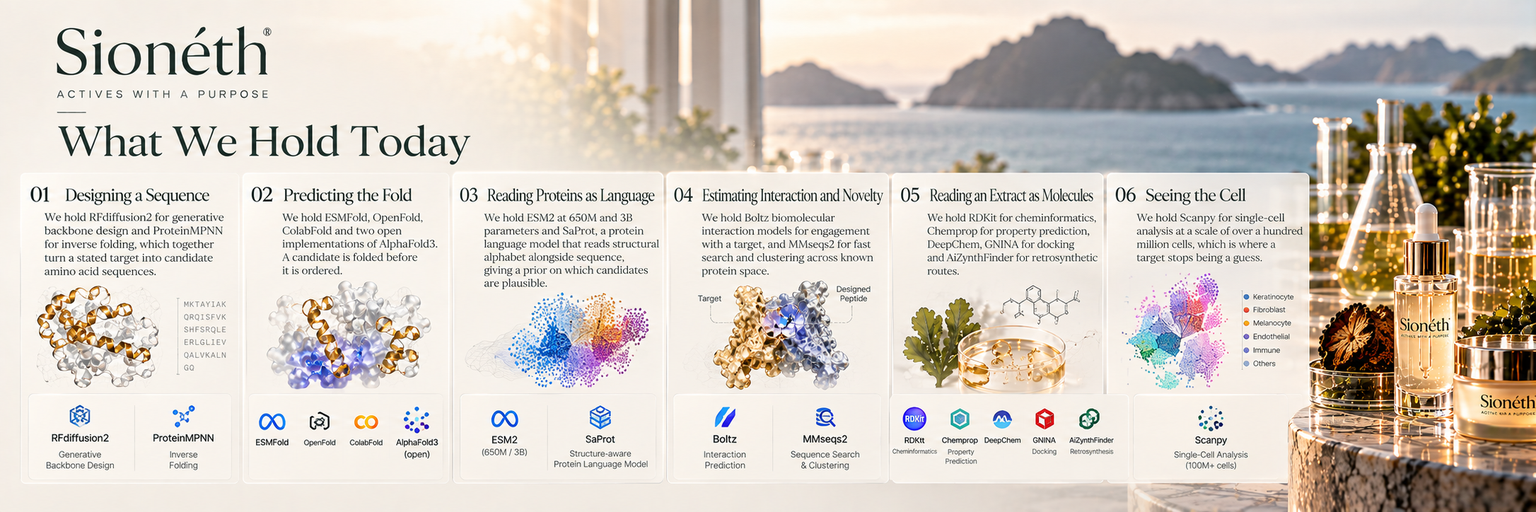
We hold RFdiffusion2 for generative backbone design and ProteinMPNN for inverse folding, which together turn a stated target into candidate amino acid sequences.
We hold ESMFold, OpenFold, ColabFold and two open implementations of AlphaFold3. A candidate is folded before it is ordered.
We hold ESM2 at 650M and 3B parameters and SaProt, a protein language model that reads structural alphabet alongside sequence, giving a prior on which candidates are plausible.
We hold the Boltz biomolecular interaction models for engagement with a target, and MMseqs2 for fast search and clustering across known protein space.
We hold RDKit for cheminformatics, Chemprop for property prediction, DeepChem, GNINA for docking and AiZynthFinder for retrosynthetic routes.
We hold Scanpy for single-cell analysis at a scale of over a hundred million cells, which is where a target stops being a guess.

The prototype line launched in 2022 with Chaga mushroom extract and fermented seaweed extract from Jeju Island. Three years of user feedback from across the globe sit behind the current range.
The relaunch under the Sionéth name is scheduled for the first half of 2027. It is the first line built to the definition above rather than assembled from ingredients and named afterwards.
Formulation and fermentation work in Korea, source material from African growers. The pairing is a supply and process arrangement, and it is held to the same records as the design work so that neither side drifts unnoticed.
Sionéth shares the group's molecular and protein tooling with its research work, which is why a skincare range has a design stack behind it at all.
Extending the designed-peptide work from the first active across every product in the line, and building the batch records into something a formulator can query rather than read.
"An active you can point to, a carrier you can describe, and a record that connects both to the bottle in your hand."
Sionéth — Designed Skincare Actives.