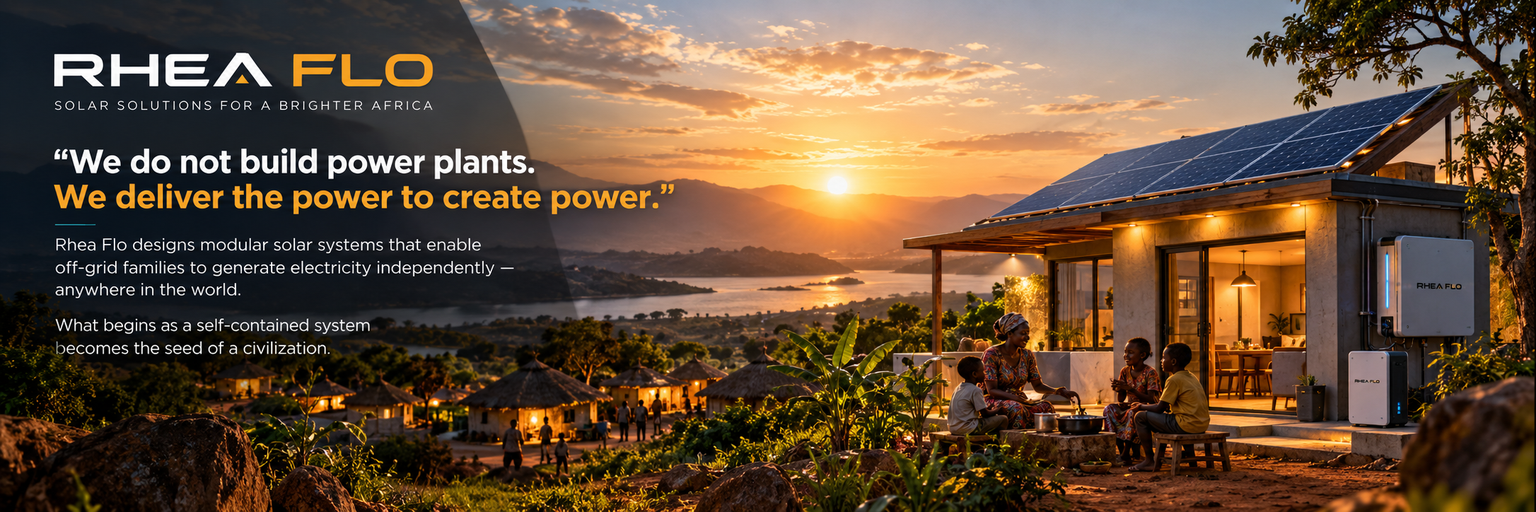
"We do not build power plants. We deliver the power to create power."
Rhea Flo designs modular solar systems that enable off-grid families to generate electricity independently — anywhere in the world.
We do not build power plants. We deliver the power to create power. What begins as a self-contained system becomes the seed of a civilization.
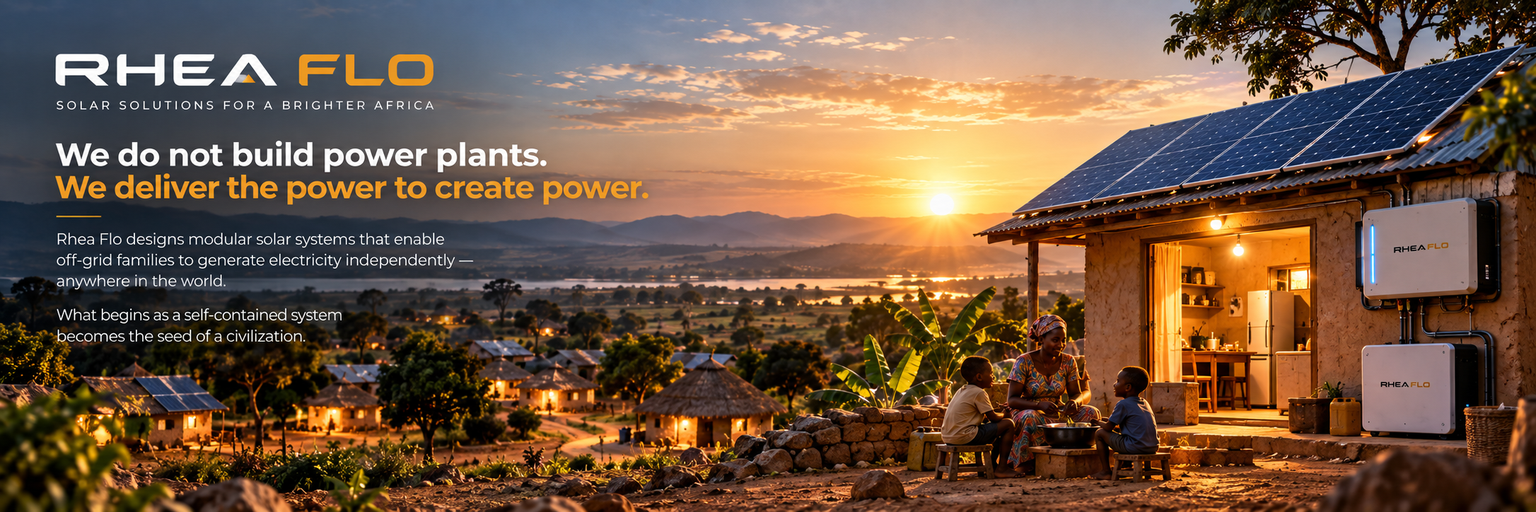
A national grid is built outward from the places that can pay for it. Households beyond the last pole are not waiting for technology to be invented; they are waiting for a line that, on present economics, is never going to be run to them.
Where there is no line there is kerosene, candles and a diesel generator shared between neighbours. All three are bought again every month, and all three cost more per unit of light than the grid the household cannot reach.
Community-scale generation needs land, permits, a distribution network and an operator. It is the right instrument for a town and the wrong one for a dispersed settlement of forty houses that each need a few hundred watts.
Equipment that needs a certified technician to commission it cannot be deployed where no certified technician lives. Anything that cannot be assembled by the household itself will not be assembled at all.
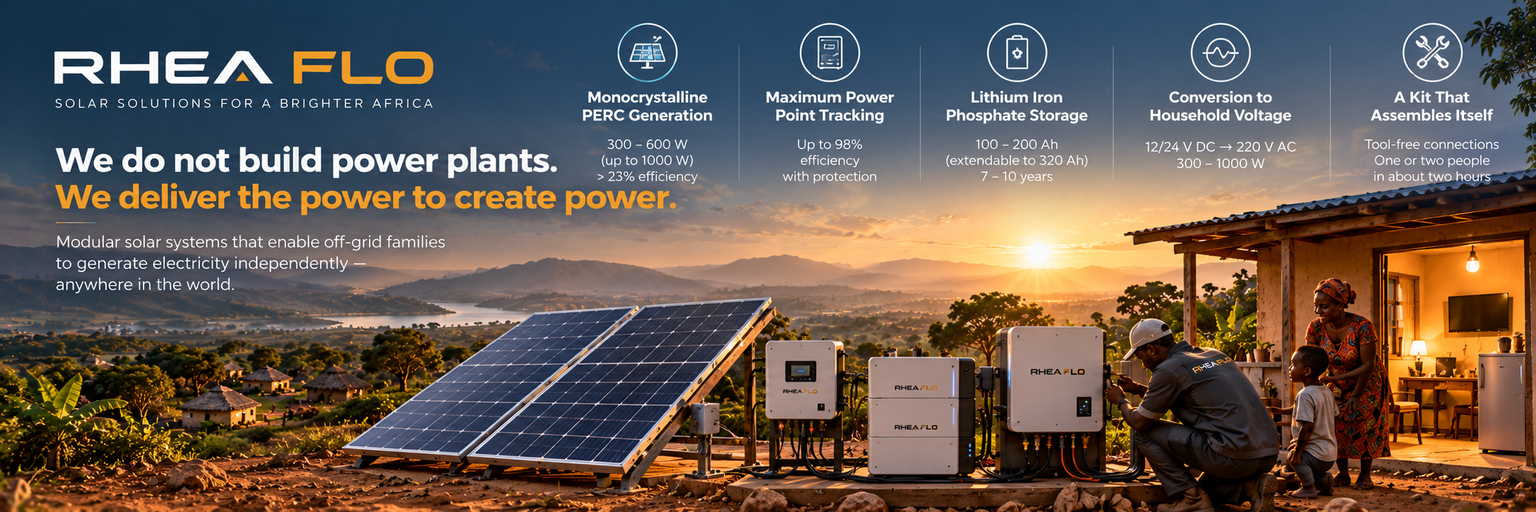
Panels rated at 300 to 600 W using high-efficiency monocrystalline PERC cells, with an enhanced configuration reaching 1000 W at cell efficiency above 23%. The rating is chosen from a modelled year of irradiance at that latitude and tilt, not from a catalogue.
An MPPT controller converting at up to 98% efficiency with reverse-current protection. It is the component that decides how much of the light striking the panel actually reaches the battery as charge.
LiFePO4 packs of 100 to 200 Ah with a safety-grade battery management system, extending to 320 Ah where the household needs to ride through two to three days of cloud. Which pack a site needs falls out of modelling generation and household load together rather than from a rule of thumb. Service life is 7 to 10 years.
A DC/AC inverter taking 12 or 24 V from the pack and delivering 220 V AC at 300 to 1000 W, so ordinary appliances work without adaptation.
Waterproof cabling, brackets and junction boxes are supplied as one modular set with tool-free connections. One or two people bring a system online within two hours and no technical training is required.
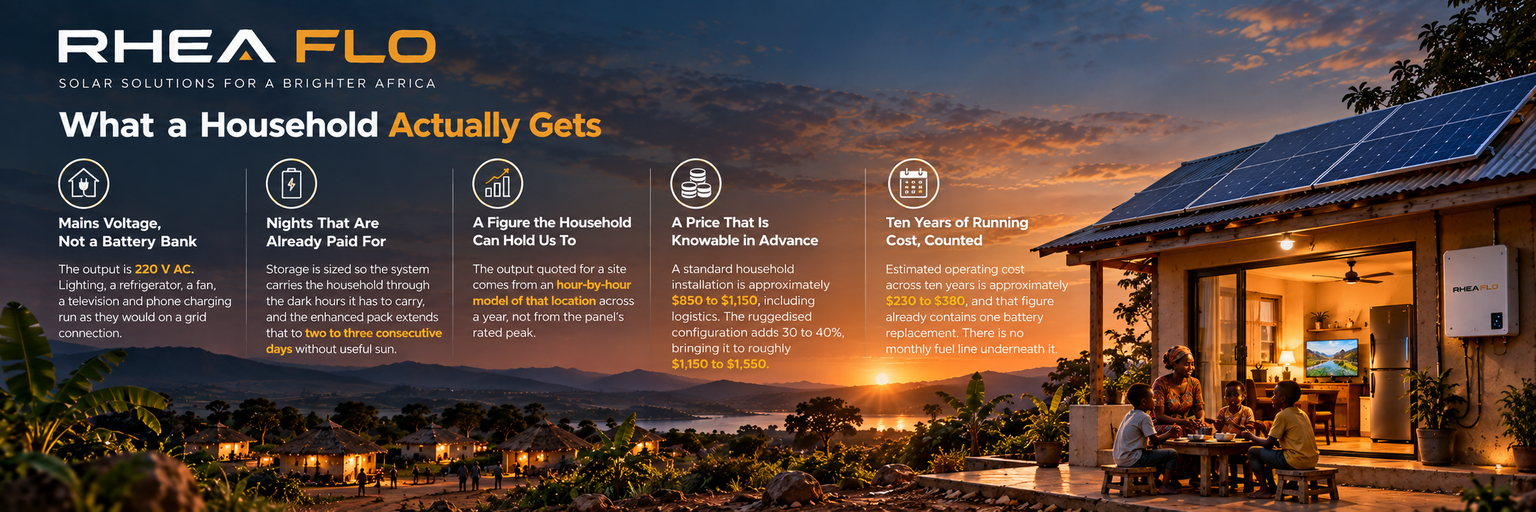
The output is 220 V AC. Lighting, a refrigerator, a fan, a television and phone charging run as they would on a grid connection, which is the difference between an energy product and an energy appliance.
Storage is sized so the system carries the household through the dark hours it has to carry, and the enhanced pack extends that to two or three consecutive days without useful sun.
The output quoted for a site comes from an hour-by-hour model of that location across a year, not from the panel’s rated peak. It is the difference between what the hardware can do at noon in a laboratory and what the household will actually see in July.
A standard household installation is approximately $850 to $1,150 including logistics. The ruggedised configuration adds 30 to 40%, bringing it to roughly $1,150 to $1,550.
Estimated operating cost across ten years is approximately $230 to $380, and that figure already contains one battery replacement. There is no monthly fuel line underneath it.
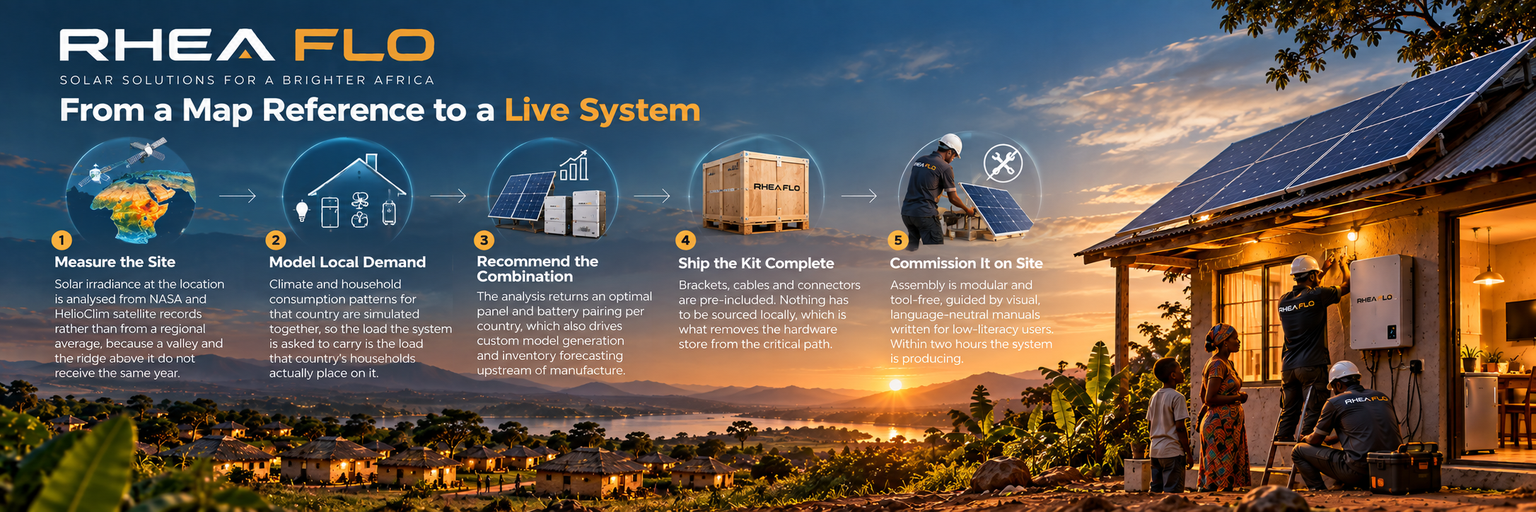
Solar irradiance at the location is analysed from NASA and HelioClim satellite records rather than from a regional average, because a valley and the ridge above it do not receive the same year.
Climate and household consumption patterns for that country are simulated together, so the load the system is asked to carry is the load that country's households actually place on it.
The analysis returns an optimal panel and battery pairing per country, which also drives custom model generation and inventory forecasting upstream of manufacture.
Brackets, cables and connectors are pre-included. Nothing has to be sourced locally, which is what removes the hardware store from the critical path.
Assembly is modular and tool-free, guided by visual, language-neutral manuals written for low-literacy users. Within two hours the system is producing.
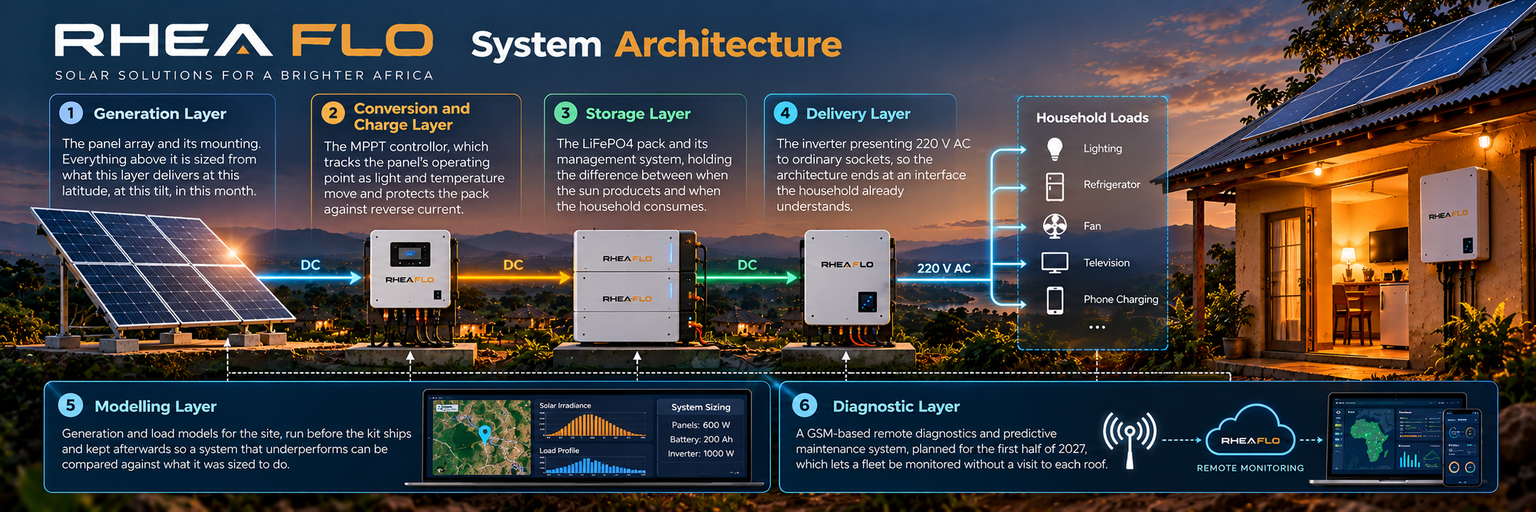
The panel array and its mounting. Everything above it is sized from what this layer delivers at this latitude, at this tilt, in this month.
The MPPT controller, which tracks the panel's operating point as light and temperature move and protects the pack against reverse current.
The LiFePO4 pack and its management system, holding the difference between when the sun produces and when the household consumes.
The inverter presenting 220 V AC to ordinary sockets, so the architecture ends at an interface the household already understands.
Generation and load models for the site, run before the kit ships and kept afterwards so a system that underperforms can be compared against what it was sized to do.
A GSM-based remote diagnostics and predictive maintenance system, planned for the first half of 2027, which lets a fleet be monitored without a visit to each roof.
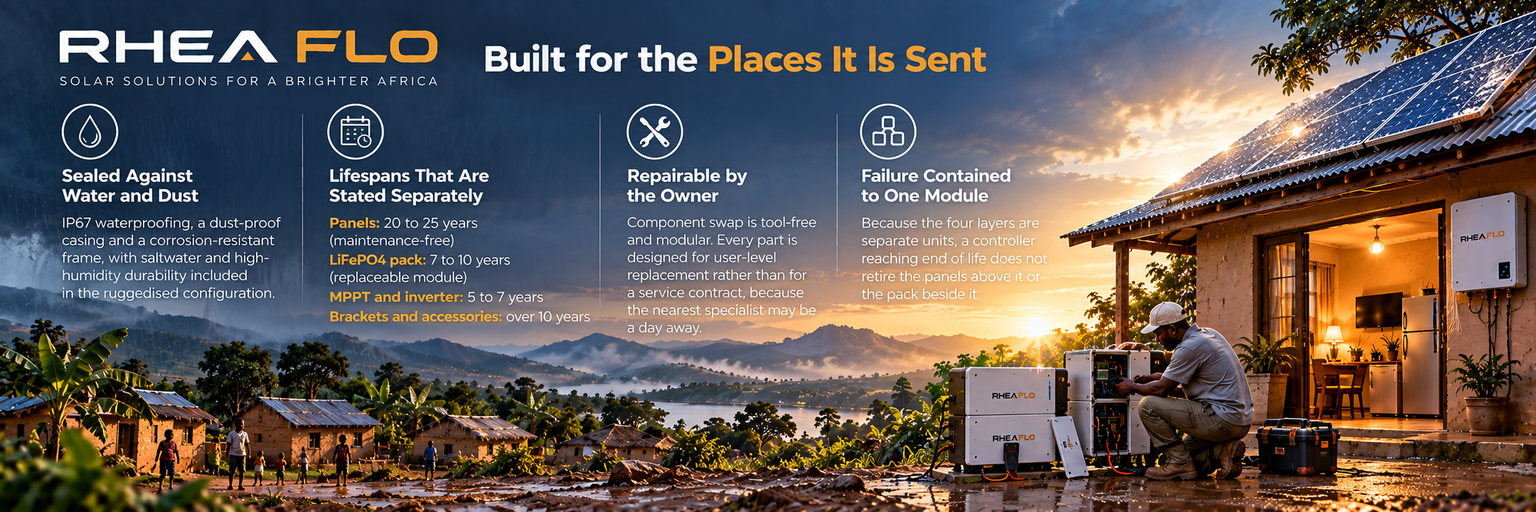
IP67 waterproofing, a dust-proof casing and a corrosion-resistant frame, with saltwater and high-humidity durability included in the ruggedised configuration.
Panels 20 to 25 years and maintenance-free; the LiFePO4 pack 7 to 10 years as a replaceable module; MPPT and inverter 5 to 7 years; brackets and accessories over 10 years. A system is not one lifetime but four.
Component swap is tool-free and modular. Every part is designed for user-level replacement rather than for a service contract, because the nearest specialist may be a day away.
Because the four layers are separate units, a controller reaching end of life does not retire the panels above it or the pack beside it.
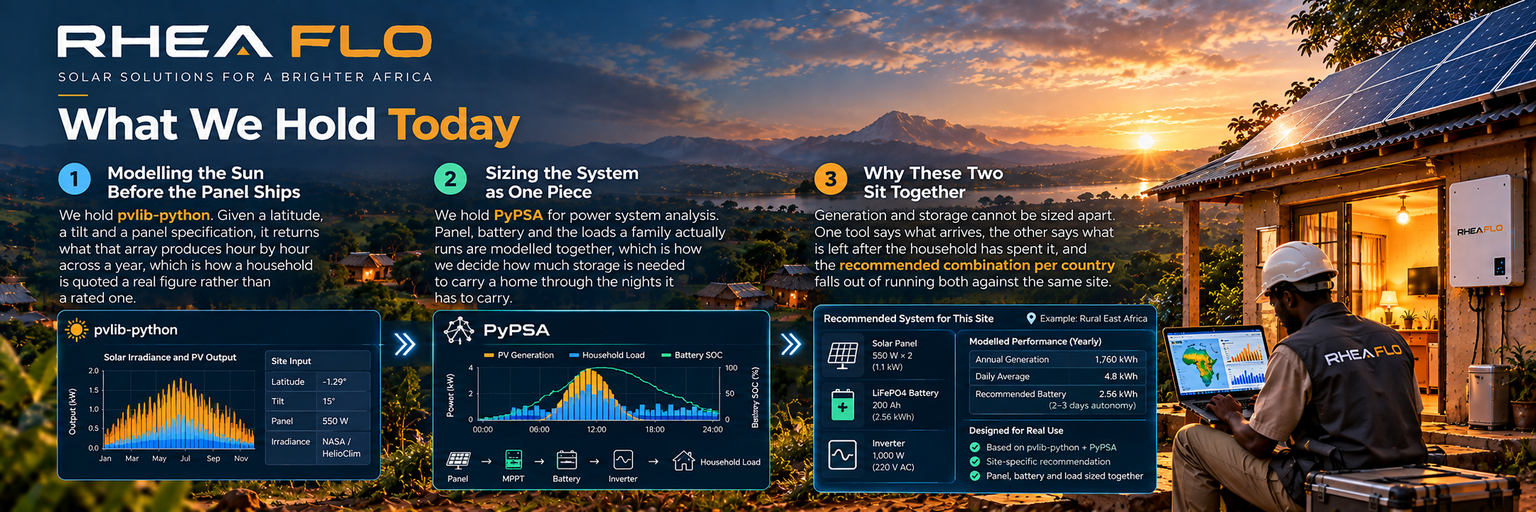
We hold pvlib-python. Given a latitude, a tilt and a panel specification, it returns what that array produces hour by hour across a year, which is how a household is quoted a real figure rather than a rated one.
We hold PyPSA for power system analysis. Panel, battery and the loads a family actually runs are modelled together, which is how we decide how much storage is needed to carry a home through the nights it has to carry.
Generation and storage cannot be sized apart. One tool says what arrives, the other says what is left after the household has spent it, and the recommended combination per country falls out of running both against the same site.
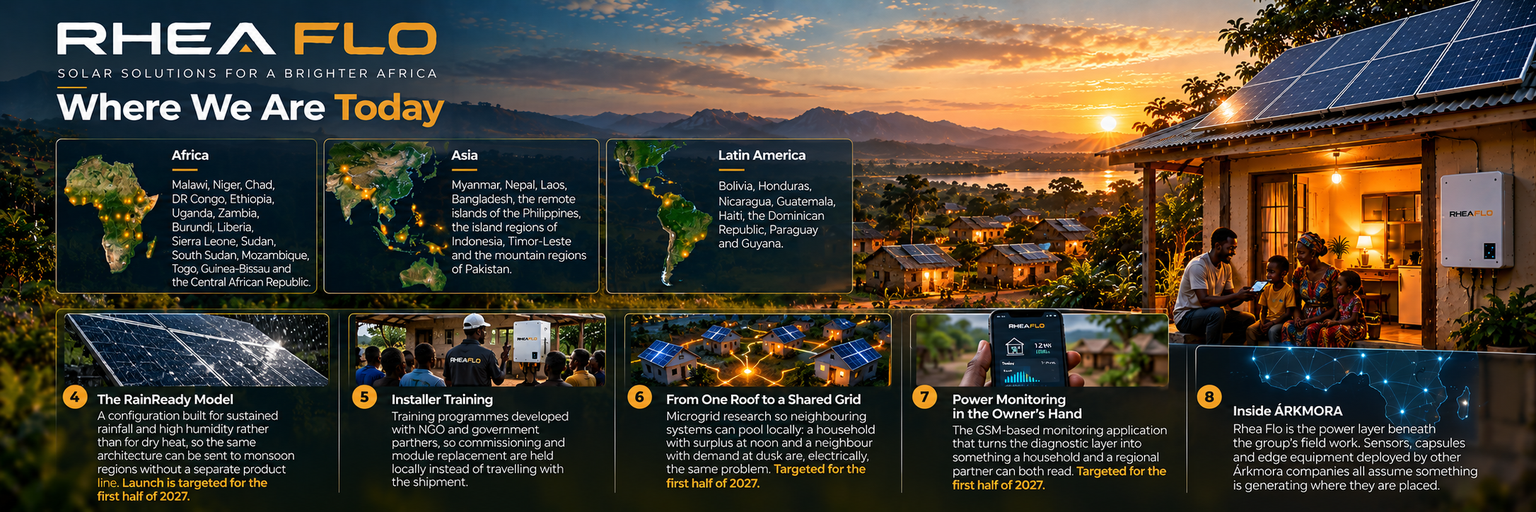
Malawi, Niger, Chad, DR Congo, Ethiopia, Uganda, Zambia, Burundi, Liberia, Sierra Leone, Sudan, South Sudan, Mozambique, Togo, Guinea-Bissau and the Central African Republic.
Myanmar, Nepal, Laos, Bangladesh, the remote islands of the Philippines, the island regions of Indonesia, Timor-Leste and the mountain regions of Pakistan.
Bolivia, Honduras, Nicaragua, Guatemala, Haiti, the Dominican Republic, Paraguay and Guyana.
A configuration built for sustained rainfall and high humidity rather than for dry heat, so the same architecture can be sent to monsoon regions without a separate product line. Launch is targeted for the first half of 2027.
Training programmes developed with NGO and government partners, so commissioning and module replacement are held locally instead of travelling with the shipment.
Microgrid research so neighbouring systems can pool locally: a household with surplus at noon and a neighbour with demand at dusk are, electrically, the same problem. Targeted for the first half of 2027.
The GSM-based monitoring application that turns the diagnostic layer into something a household and a regional partner can both read. Targeted for the first half of 2027.
Rhea Flo is the power layer beneath the group's field work. Sensors, capsules and edge equipment deployed by other Árkmora companies all assume something is generating where they are placed.
"We do not build power plants. We deliver the power to create power. What begins as one rooftop becomes the seed of a civilization."
Rhea Flo — Power the World, One Rooftop at a Time.