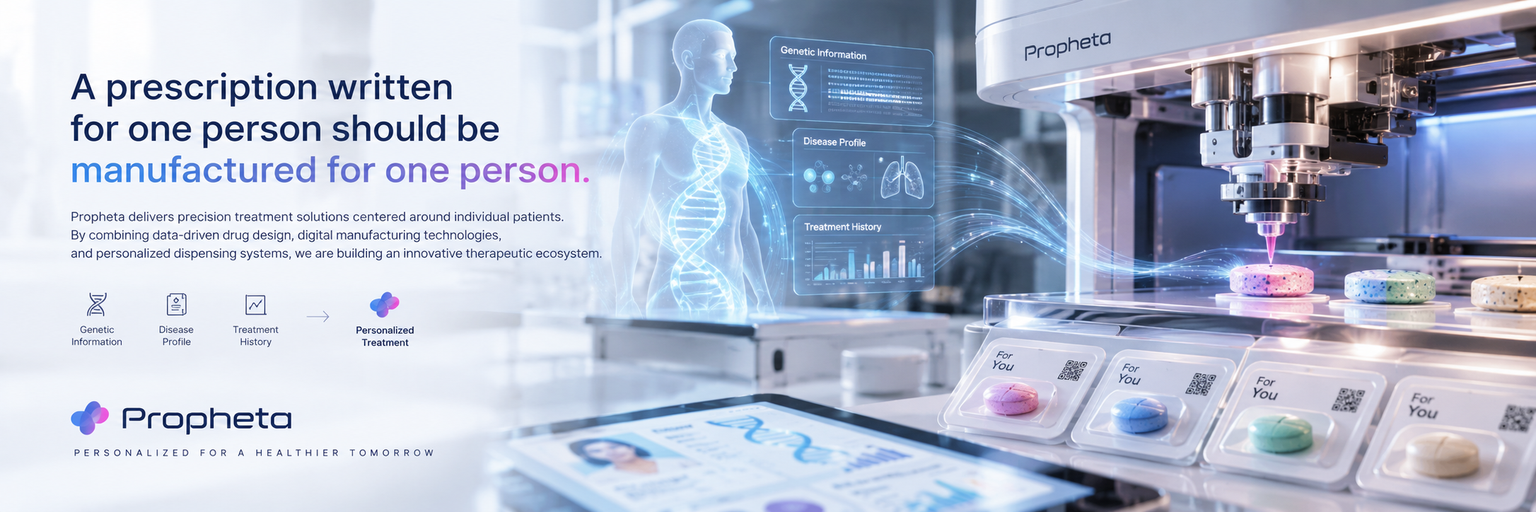
"A prescription written for one person should be manufactured for one person."
As a 3D printing-based personalized pharmaceutical manufacturing company, Propheta delivers precision treatment solutions centered around individual patients. By combining data-driven drug design, digital manufacturing technologies, and personalized dispensing systems, we are building an innovative therapeutic ecosystem.
The 21st-century pharmaceutical industry is evolving beyond natural compounds to embrace digital precision manufacturing. At Propheta, we utilize 3D bioprinting technology to design and print customized treatments based on a patient's genetic information, disease profile, and treatment history.
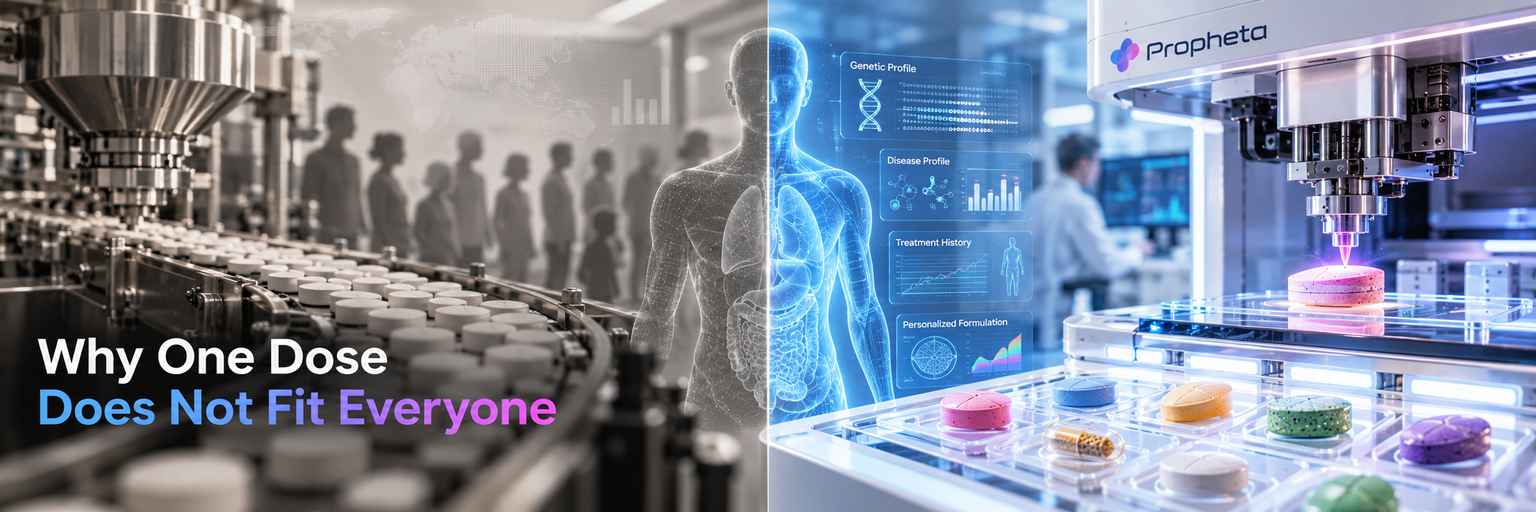
A tablet made in the millions is designed for a population, not a person. Dose, release rate and the distribution of active ingredient are fixed at the factory, and the patient standing in front of a prescriber is fitted to the product rather than the other way around.
Rare diseases, paediatric care and complex chronic conditions are exactly where the standard dose fails, and exactly where a manufacturer has least commercial reason to make a special one.
Medicines are produced in distant factories and carried to the patient. Every step of that journey is a delay, a cost and a point at which a tailored product stops being economic.
A dosage form a patient can actually take on the schedule they were given is not a comfort feature. It is the difference between a prescription that works and one that is abandoned.
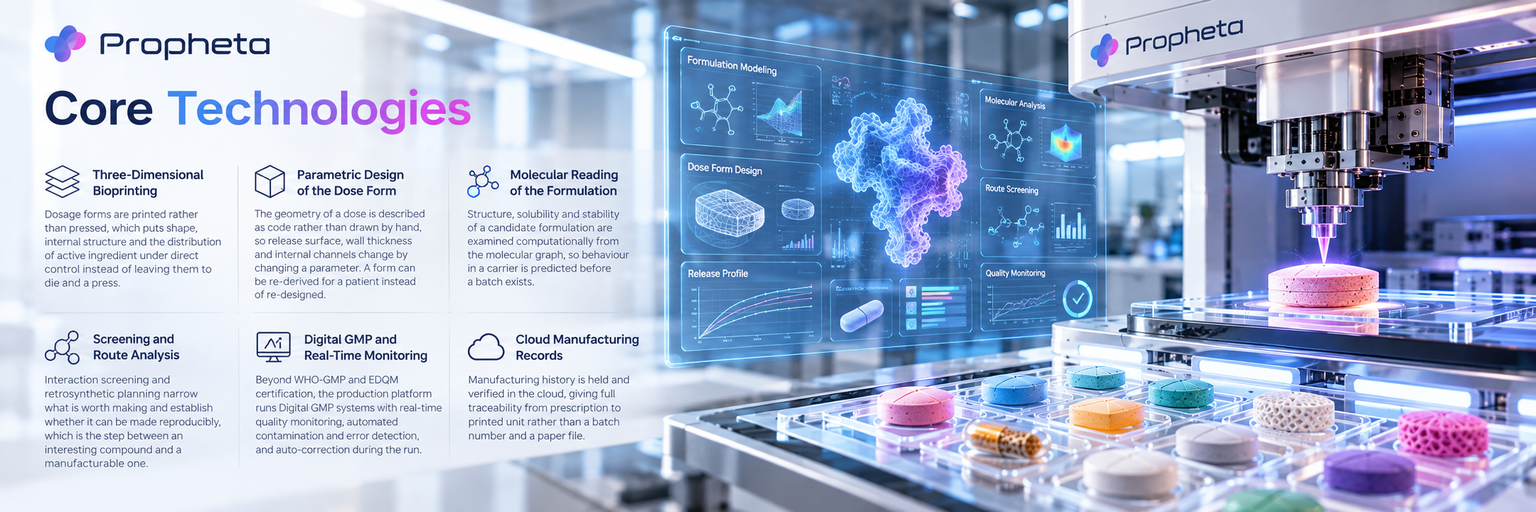
Dosage forms are printed rather than pressed, which puts shape, internal structure and the distribution of active ingredient under direct control instead of leaving them to a die and a press.
The geometry of a dose is described as code rather than drawn by hand, so release surface, wall thickness and internal channels change by changing a parameter. A form can be re-derived for a patient instead of re-designed.
Structure, solubility and stability of a candidate formulation are examined computationally from the molecular graph, so behaviour in a carrier is predicted before a batch exists.
Interaction screening and retrosynthetic planning narrow what is worth making and establish whether it can be made reproducibly, which is the step between an interesting compound and a manufacturable one.
Beyond WHO-GMP and EDQM certification, the production platform runs Digital GMP systems with real-time quality monitoring, automated contamination and error detection, and auto-correction during the run.
Manufacturing history is held and verified in the cloud, giving full traceability from prescription to printed unit rather than a batch number and a paper file.
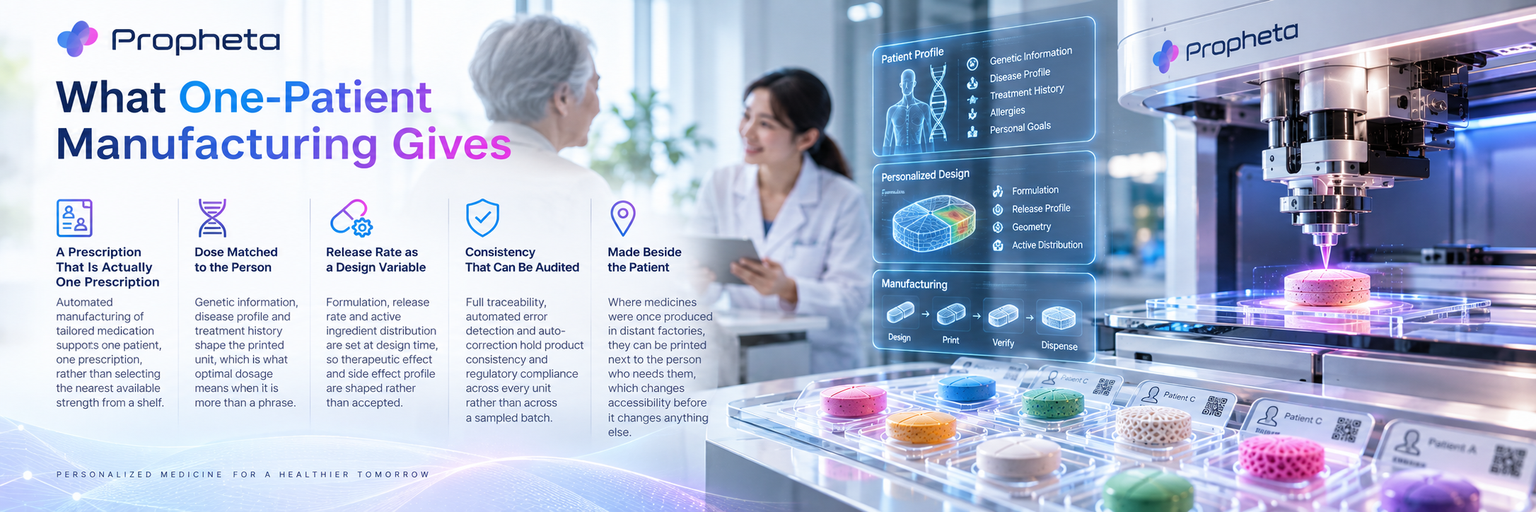
Automated manufacturing of tailored medication supports one patient, one prescription, rather than selecting the nearest available strength from a shelf.
Genetic information, disease profile and treatment history shape the printed unit, which is what optimal dosage means when it is more than a phrase.
Formulation, release rate and active ingredient distribution are set at design time, so therapeutic effect and side effect profile are shaped rather than accepted.
Full traceability, automated error detection and auto-correction hold product consistency and regulatory compliance across every unit rather than across a sampled batch.
Where medicines were once produced in distant factories, they can be printed next to the person who needs them, which changes accessibility before it changes anything else.
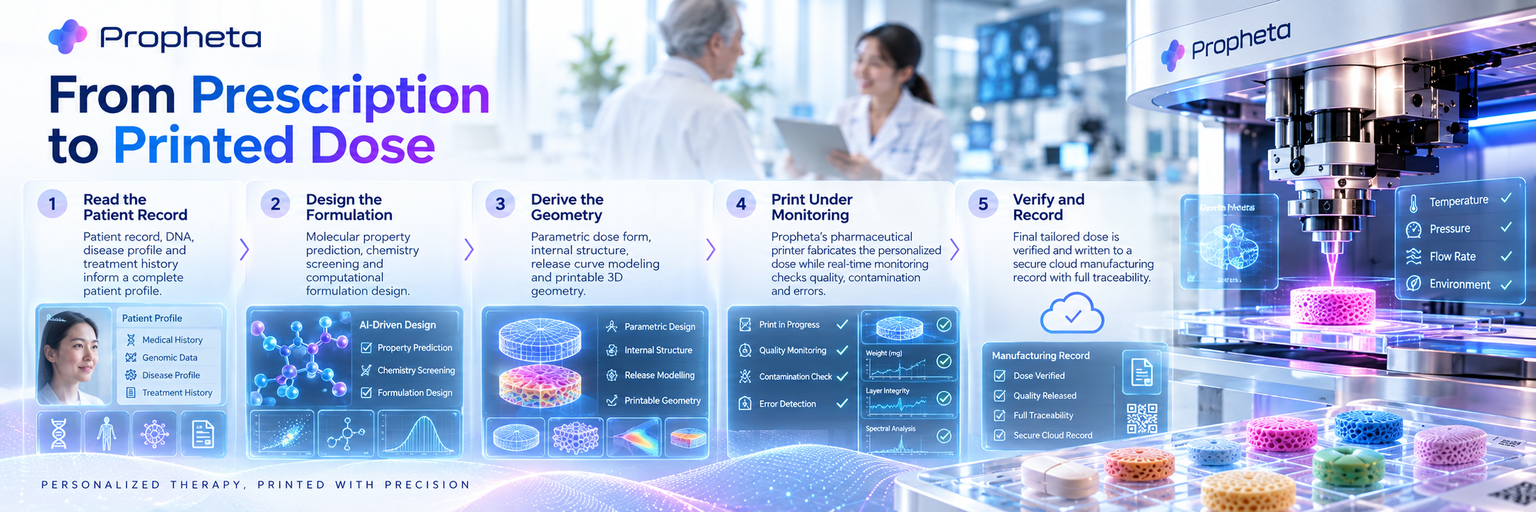
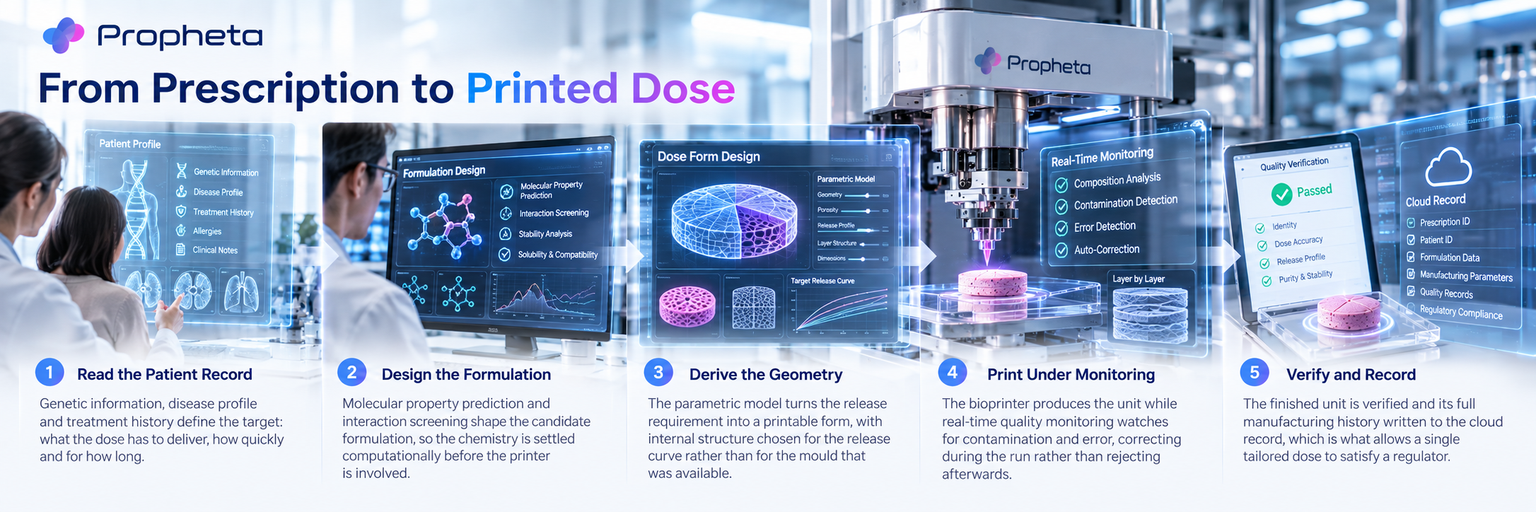
Genetic information, disease profile and treatment history define the target: what the dose has to deliver, how quickly and for how long.
Molecular property prediction and interaction screening shape the candidate formulation, so the chemistry is settled computationally before the printer is involved.
The parametric model turns the release requirement into a printable form, with internal structure chosen for the release curve rather than for the mould that was available.
The bioprinter produces the unit while real-time quality monitoring watches for contamination and error, correcting during the run rather than rejecting afterwards.
The finished unit is verified and its full manufacturing history written to the cloud record, which is what allows a single tailored dose to satisfy a regulator.
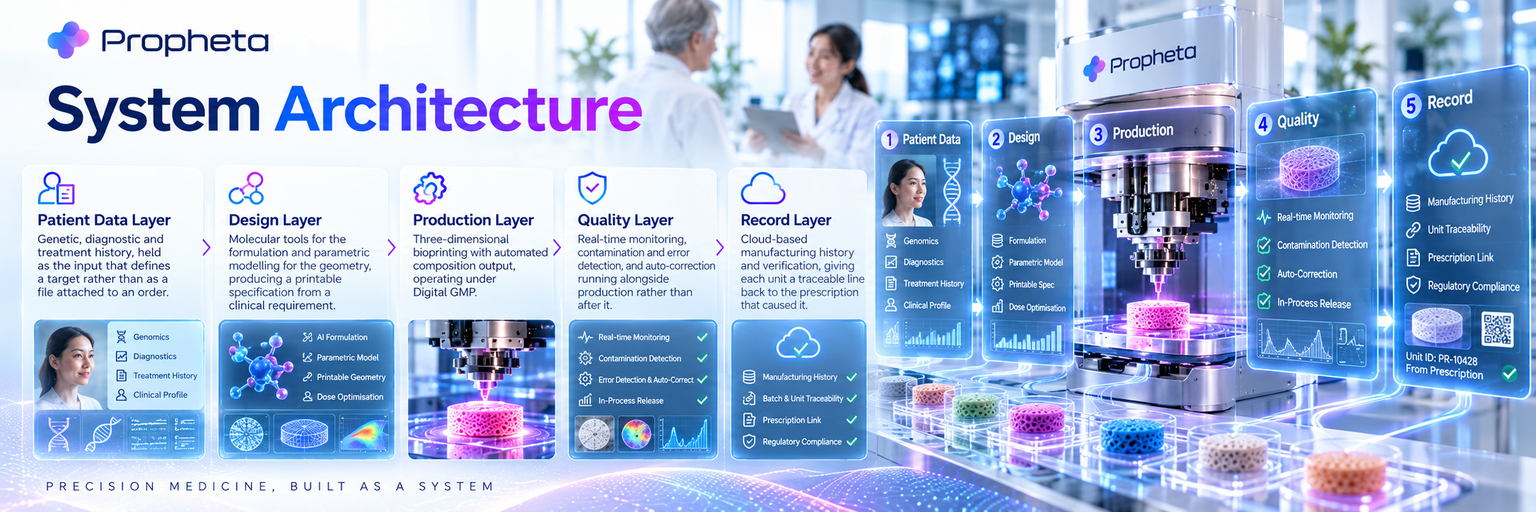
Genetic, diagnostic and treatment history, held as the input that defines a target rather than as a file attached to an order.
Molecular tools for the formulation and parametric modelling for the geometry, producing a printable specification from a clinical requirement.
Three-dimensional bioprinting with automated composition output, operating under Digital GMP.
Real-time monitoring, contamination and error detection, and auto-correction running alongside production rather than after it.
Cloud-based manufacturing history and verification, giving each unit a traceable line back to the prescription that caused it.
WHO-GMP and EDQM certification are the starting point, with Digital GMP systems layered above them for a production model that makes each unit different by design.
Contamination and error detection operate during production with auto-correction, because a one-patient batch cannot be discarded and repeated the way a mass batch can.
Full traceability means an individual printed dose can be reconstructed from its record, which is the condition for regulators to accept personalised manufacturing at all.
The units differ from one another by intent. What has to be identical is the process that produced them, and that is what the platform holds constant.
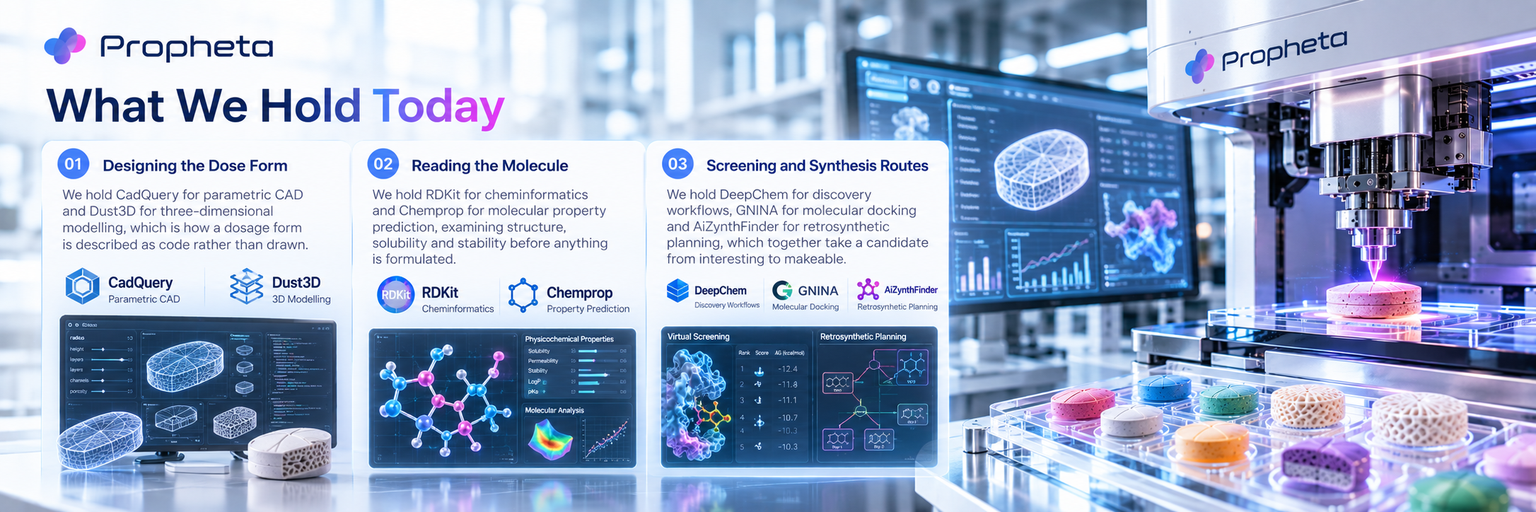
We hold CadQuery for parametric CAD and Dust3D for three-dimensional modelling, which is how a dosage form is described as code rather than drawn.
We hold RDKit for cheminformatics and Chemprop for molecular property prediction, examining structure, solubility and stability before anything is formulated.
We hold DeepChem for discovery workflows, GNINA for molecular docking and AiZynthFinder for retrosynthetic planning, which together take a candidate from interesting to makeable.
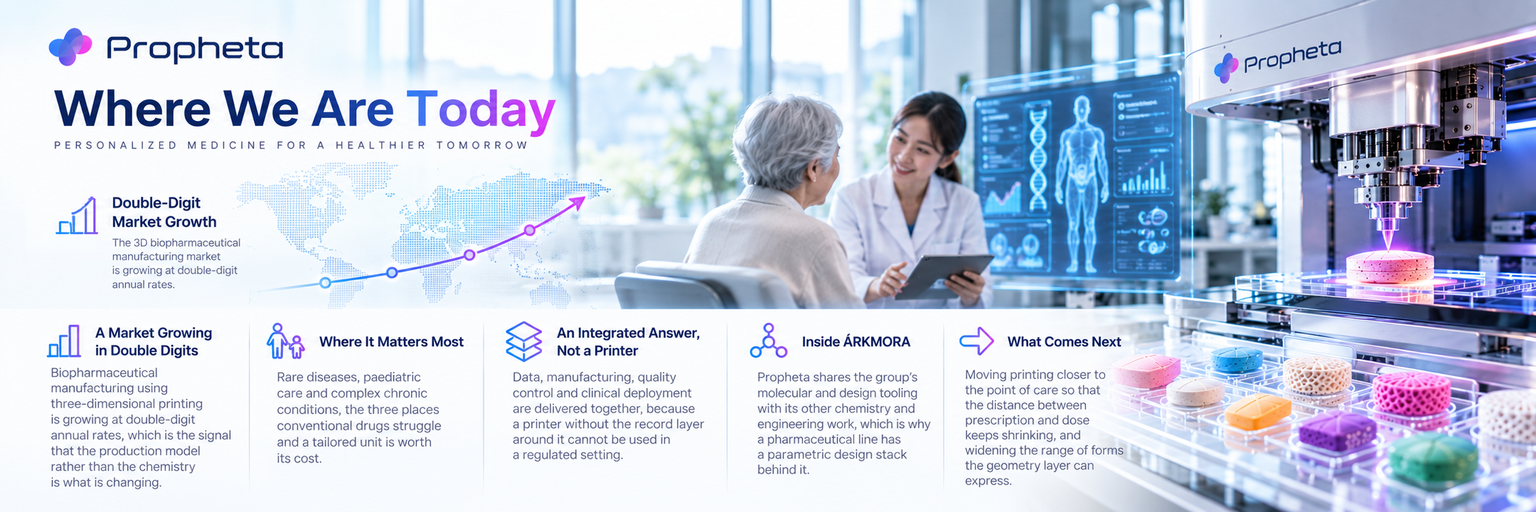
Biopharmaceutical manufacturing using three-dimensional printing is growing at double-digit annual rates, which is the signal that the production model rather than the chemistry is what is changing.
Rare diseases, paediatric care and complex chronic conditions, the three places conventional drugs struggle and a tailored unit is worth its cost.
Data, manufacturing, quality control and clinical deployment are delivered together, because a printer without the record layer around it cannot be used in a regulated setting.
Propheta shares the group's molecular and design tooling with its other chemistry and engineering work, which is why a pharmaceutical line has a parametric design stack behind it.
Moving printing closer to the point of care so that the distance between prescription and dose keeps shrinking, and widening the range of forms the geometry layer can express.
"Where drugs were once made in distant factories, they can now be printed beside the patient. Propheta is printing the future of medicine."
Propheta — Precision Medicine, Personalized.