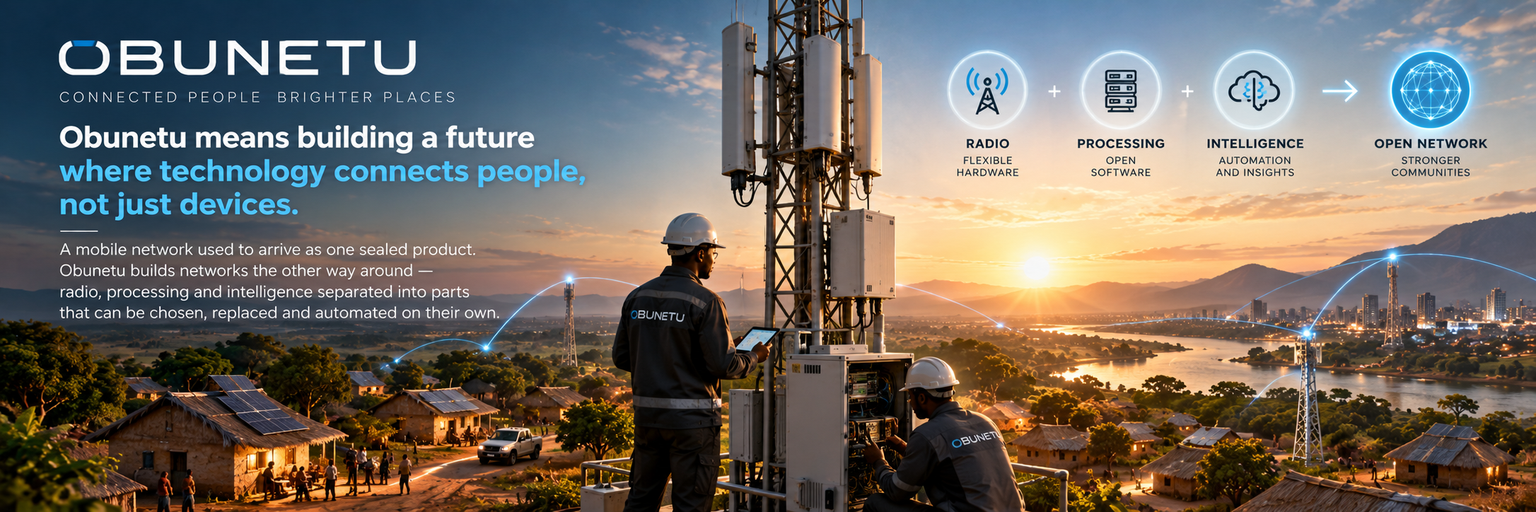
"Obunetu means building a future where technology connects people, not just devices."
A mobile network used to arrive as one sealed product. The radio, the software that drove it and the tools that managed it came from a single supplier, priced together and upgraded together. Where that price did not work, coverage simply stopped.
Obunetu builds networks the other way around — radio, processing and intelligence separated into parts that can be chosen, replaced and automated on their own.
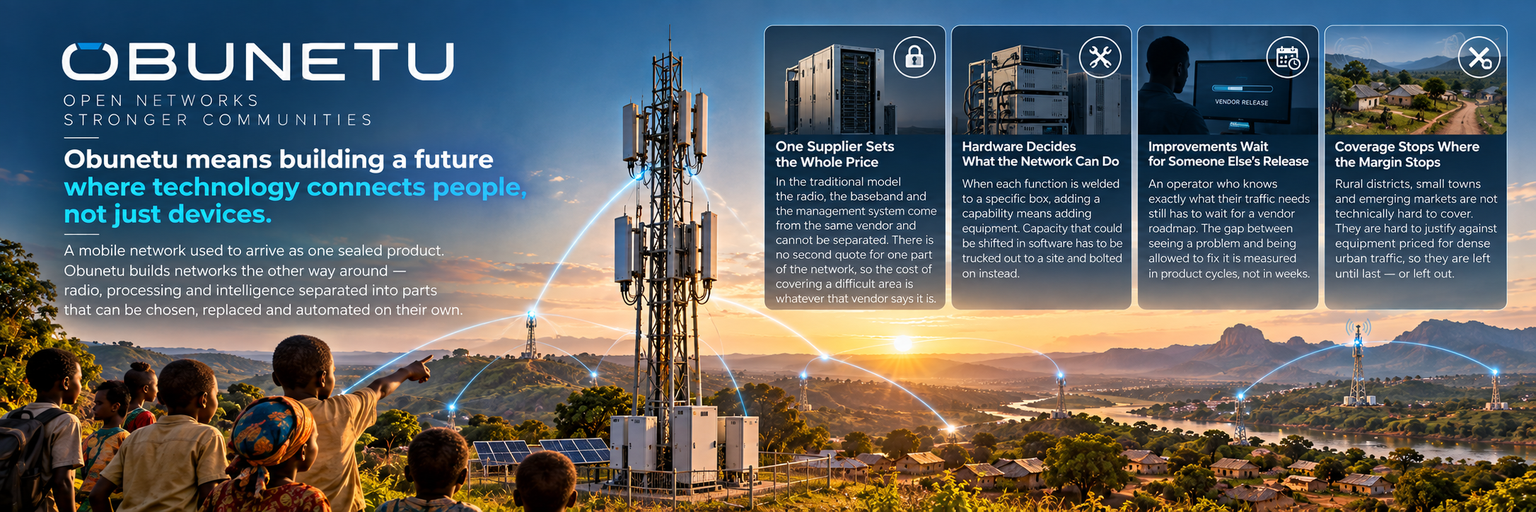
In the traditional model the radio, the baseband and the management system come from the same vendor and cannot be separated. There is no second quote for one part of the network, so the cost of covering a difficult area is whatever that vendor says it is.
When each function is welded to a specific box, adding a capability means adding equipment. Capacity that could be shifted in software has to be trucked out to a site and bolted on instead.
An operator who knows exactly what their traffic needs still has to wait for a vendor roadmap. The gap between seeing a problem and being allowed to fix it is measured in product cycles, not in weeks.
Rural districts, small towns and emerging markets are not technically hard to cover. They are hard to justify against equipment priced for dense urban traffic, so they are left until last — or left out.
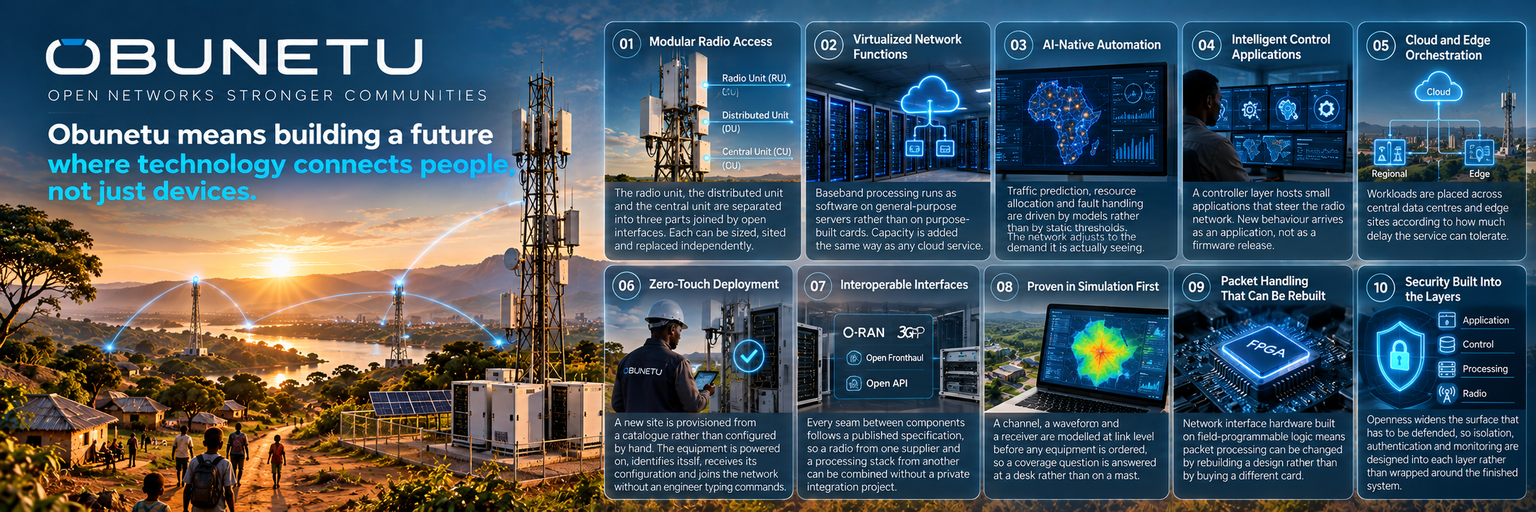
The radio unit, the distributed unit and the central unit are separated into three parts joined by open interfaces. Each can be sized, sited and replaced independently, so one deployment can put processing at the tower and another can pull it back to a regional room.
Baseband processing runs as software on general-purpose servers rather than on purpose-built cards. Capacity is added the way capacity is added to any cloud service, and the same software image serves a city cell and a village cell.
Traffic prediction, resource allocation and fault handling are driven by models rather than by static thresholds. The network adjusts to the demand it is actually seeing instead of the demand it was configured for last quarter.
A controller layer hosts small applications that steer the radio network — some reacting in near real time, others working over longer horizons. New behaviour arrives as an application, not as a firmware release.
Workloads are placed across central data centres and edge sites according to how much delay the service can tolerate. Anything that must answer quickly stays close to the user; anything that can wait runs where compute is cheapest.
A new site is provisioned from a catalogue rather than configured by hand. The equipment is powered on, identifies itself, receives its configuration and joins the network without an engineer typing commands at the cabinet.
Every seam between components follows a published specification, so a radio from one supplier and a processing stack from another can be combined without a private integration project for each pairing.
A channel, a waveform and a receiver are modelled at link level before any equipment is ordered, so a coverage question is answered at a desk rather than on a mast. The same models are how a deployment is compared against alternatives that were never built.
Network interface hardware built on field-programmable logic means packet processing can be changed by rebuilding a design rather than by buying a different card. It is what makes "software-defined" mean something physical at the edge of the network.
Openness widens the surface that has to be defended, so isolation, authentication and monitoring are designed into each layer rather than wrapped around the finished system.
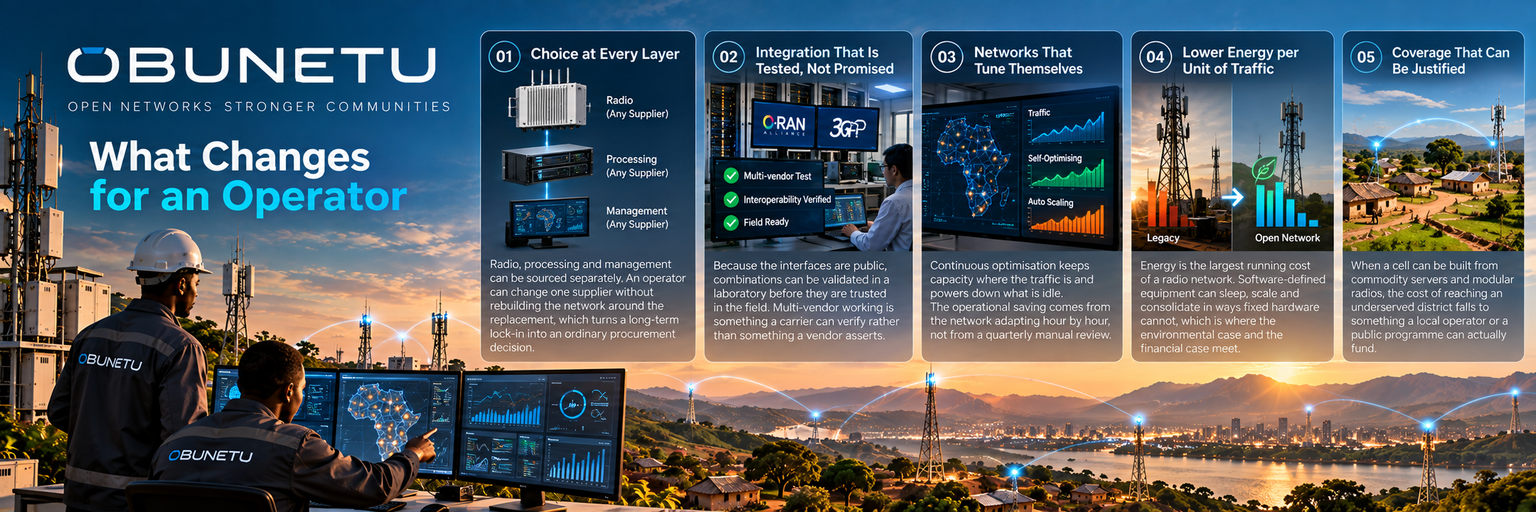
Radio, processing and management can be sourced separately. An operator can change one supplier without rebuilding the network around the replacement, which turns a long-term lock-in into an ordinary procurement decision.
Because the interfaces are public, combinations can be validated in a laboratory before they are trusted in the field. Multi-vendor working is something a carrier can verify rather than something a vendor asserts.
Continuous optimisation keeps capacity where the traffic is and powers down what is idle. The operational saving comes from the network adapting hour by hour, not from a quarterly manual review.
Energy is the largest running cost of a radio network. Software-defined equipment can sleep, scale and consolidate in ways fixed hardware cannot, which is where the environmental case and the financial case meet.
When a cell can be built from commodity servers and modular radios, the cost of reaching an underserved district falls to something a local operator or a public programme can actually fund.
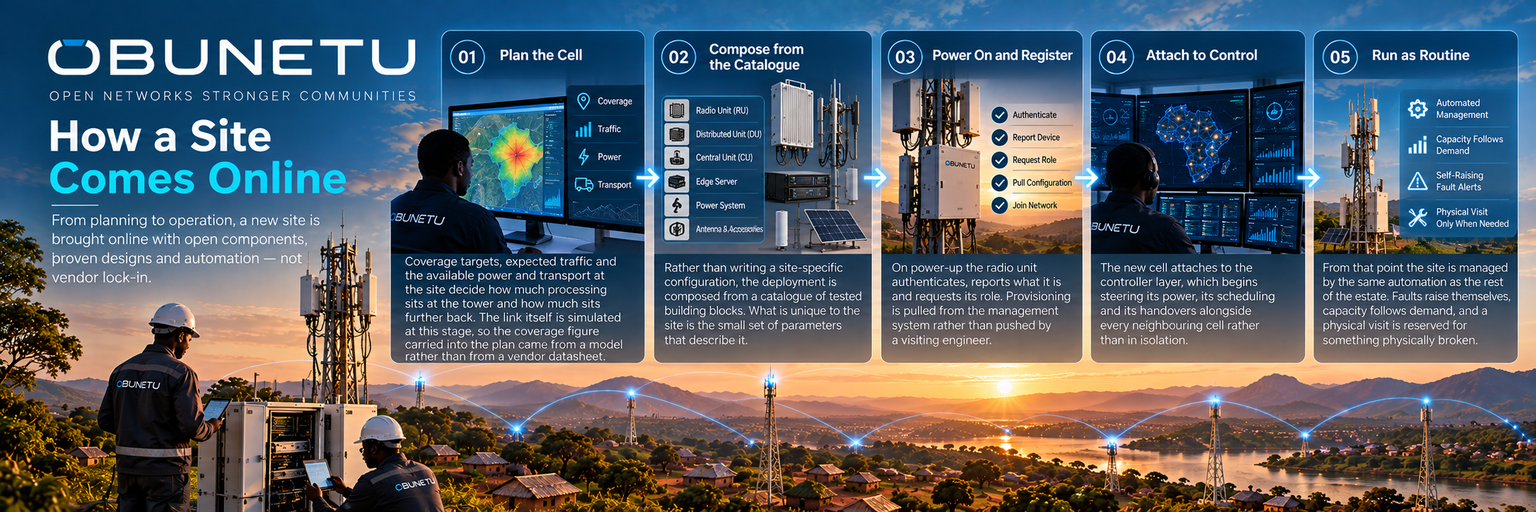
Coverage targets, expected traffic and the available power and transport at the site decide how much processing sits at the tower and how much sits further back. The link itself is simulated at this stage, so the coverage figure carried into the plan came from a model rather than from a vendor datasheet.
Rather than writing a site-specific configuration, the deployment is composed from a catalogue of tested building blocks. What is unique to the site is the small set of parameters that describe it.
On power-up the radio unit authenticates, reports what it is and requests its role. Provisioning is pulled from the management system rather than pushed by a visiting engineer.
The new cell attaches to the controller layer, which begins steering its power, its scheduling and its handovers alongside every neighbouring cell rather than in isolation.
From that point the site is managed by the same automation as the rest of the estate. Faults raise themselves, capacity follows demand, and a physical visit is reserved for something physically broken.
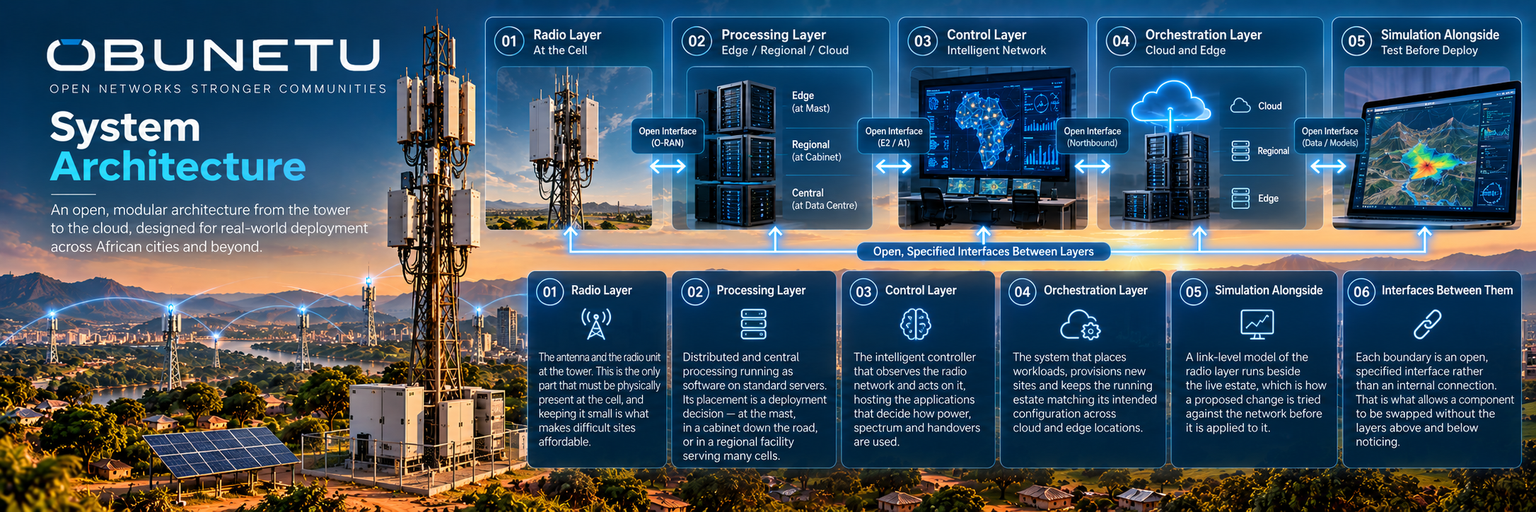
The antenna and the radio unit at the tower. This is the only part that must be physically present at the cell, and keeping it small is what makes difficult sites affordable.
Distributed and central processing running as software on standard servers. Its placement is a deployment decision — at the mast, in a cabinet down the road, or in a regional facility serving many cells.
The intelligent controller that observes the radio network and acts on it, hosting the applications that decide how power, spectrum and handovers are used.
The system that places workloads, provisions new sites and keeps the running estate matching its intended configuration across cloud and edge locations.
A link-level model of the radio layer runs beside the live estate, which is how a proposed change is tried against the network before it is applied to it.
Each boundary is an open, specified interface rather than an internal connection. That is what allows a component to be swapped without the layers above and below noticing.
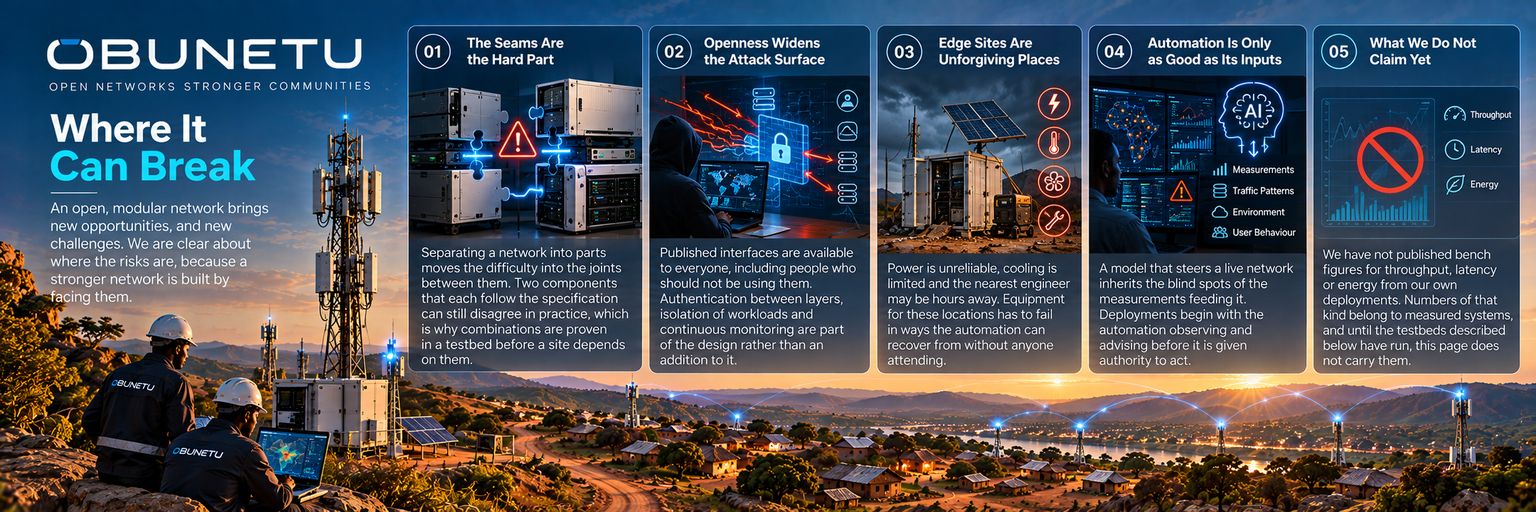
Separating a network into parts moves the difficulty into the joints between them. Two components that each follow the specification can still disagree in practice, which is why combinations are proven in a testbed before a site depends on them.
Published interfaces are available to everyone, including people who should not be using them. Authentication between layers, isolation of workloads and continuous monitoring are part of the design rather than an addition to it.
Power is unreliable, cooling is limited and the nearest engineer may be hours away. Equipment for these locations has to fail in ways the automation can recover from without anyone attending.
A model that steers a live network inherits the blind spots of the measurements feeding it. Deployments begin with the automation observing and advising before it is given authority to act.
We have not published bench figures for throughput, latency or energy from our own deployments. Numbers of that kind belong to measured systems, and until the testbeds described below have run, this page does not carry them.
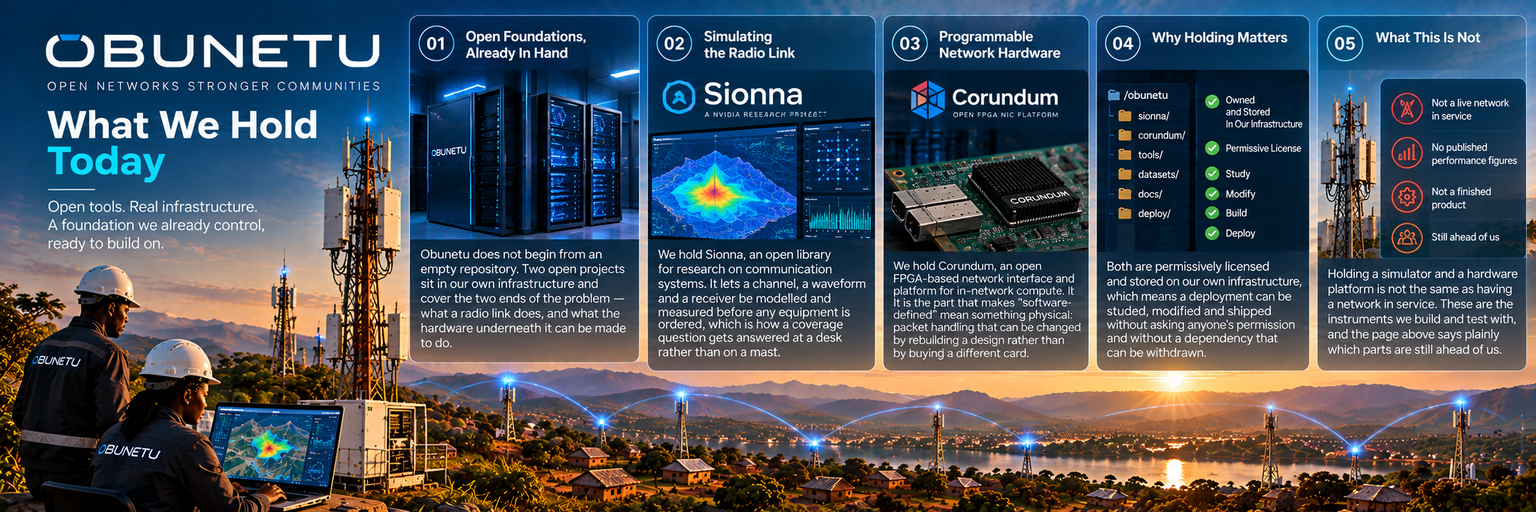
Obunetu does not begin from an empty repository. Two open projects sit in our own infrastructure and cover the two ends of the problem — what a radio link does, and what the hardware underneath it can be made to do.
We hold Sionna, an open library for research on communication systems. It lets a channel, a waveform and a receiver be modelled and measured before any equipment is ordered, which is how a coverage question gets answered at a desk rather than on a mast.
We hold Corundum, an open FPGA-based network interface and platform for in-network compute. It is the part that makes "software-defined" mean something physical: packet handling that can be changed by rebuilding a design rather than by buying a different card.
Both are permissively licensed and stored on our own infrastructure, which means a deployment can be studied, modified and shipped without asking anyone's permission and without a dependency that can be withdrawn.
Holding a simulator and a hardware platform is not the same as having a network in service. These are the instruments we build and test with, and the page above says plainly which parts are still ahead of us.
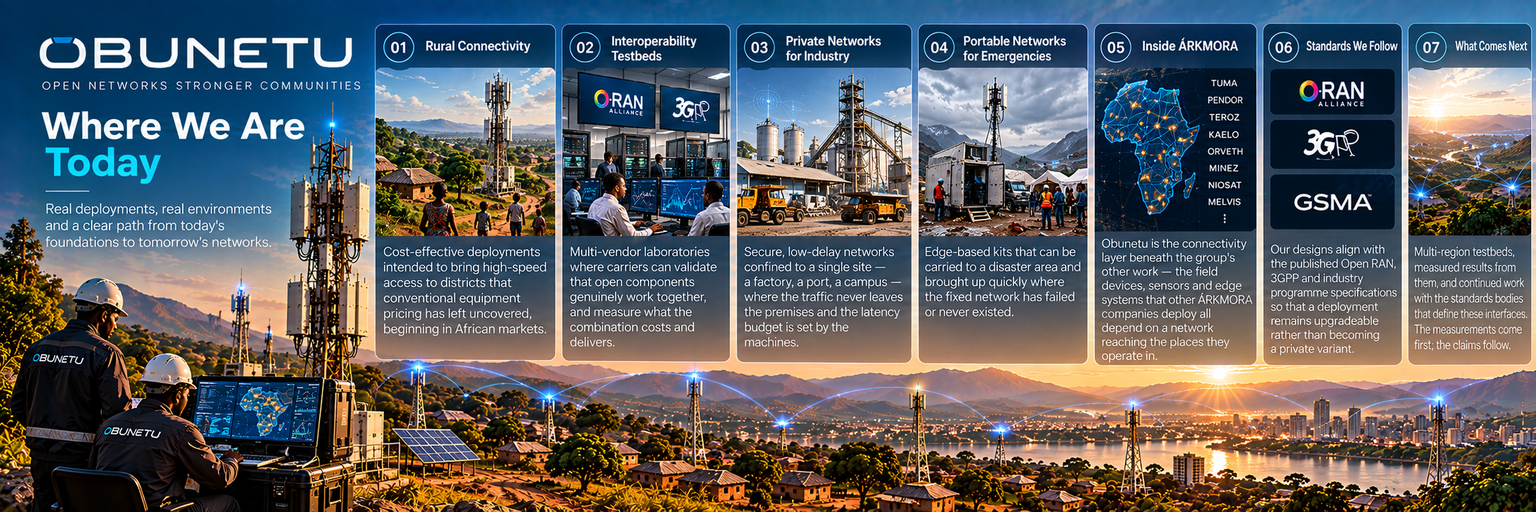
Cost-effective deployments intended to bring high-speed access to districts that conventional equipment pricing has left uncovered, beginning in African markets.
Multi-vendor laboratories where carriers can validate that open components genuinely work together, and measure what the combination costs and delivers.
Secure, low-delay networks confined to a single site — a factory, a port, a campus — where the traffic never leaves the premises and the latency budget is set by the machines.
Edge-based kits that can be carried to a disaster area and brought up quickly where the fixed network has failed or never existed.
Obunetu is the connectivity layer beneath the group's other work — the field devices, sensors and edge systems that other Árkmora companies deploy all depend on a network reaching the places they operate in.
Our designs align with the published Open RAN, 3GPP and industry programme specifications so that a deployment remains upgradeable rather than becoming a private variant.
Multi-region testbeds, measured results from them, and continued work with the standards bodies that define these interfaces. The measurements come first; the claims follow.
"A network is not finished when it works in a laboratory. It is finished when someone far from the laboratory can depend on it."
Obunetu — Open Network Infrastructure.