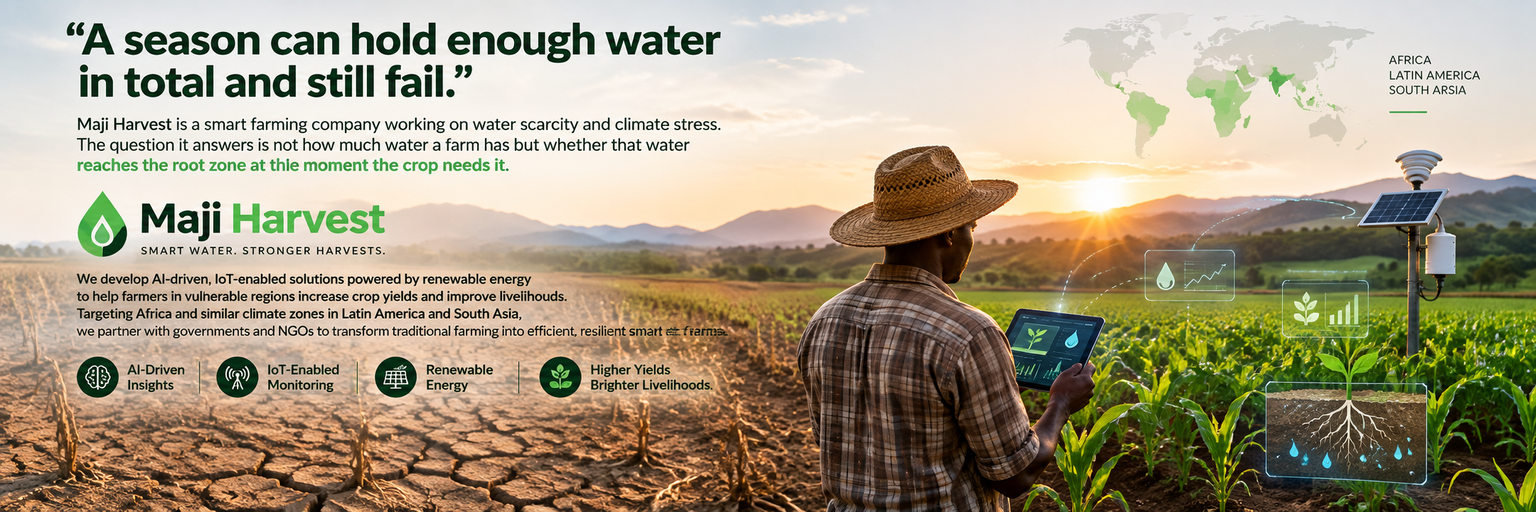
"A season can hold enough water in total and still fail."
Maji Harvest is a smart farming company working on water scarcity and climate stress. The question it answers is not how much water a farm has but whether that water reaches the root zone at the moment the crop needs it.
We develop AI-driven, IoT-enabled solutions powered by renewable energy to help farmers in vulnerable regions increase crop yields and improve livelihoods. Targeting Africa and similar climate zones in Latin America and South Asia, we partner with governments and NGOs to transform traditional farming into efficient, resilient smart farms.
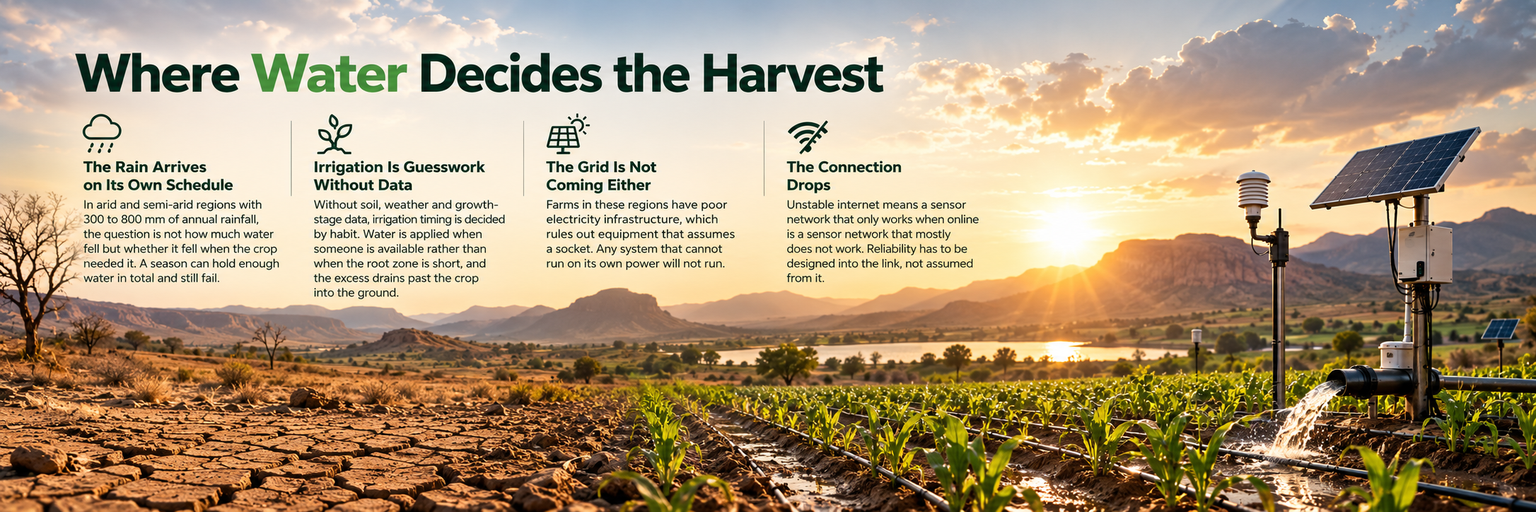
In arid and semi-arid regions with 300 to 800 mm of annual rainfall, the question is not how much water fell but whether it fell when the crop needed it. A season can hold enough water in total and still fail.
Without soil, weather and growth-stage data, irrigation timing is decided by habit. Water is applied when someone is available rather than when the root zone is short, and the excess drains past the crop into the ground.
Farms in these regions have poor electricity infrastructure, which rules out equipment that assumes a socket. Any system that cannot run on its own power will not run.
Unstable internet means a sensor network that only works when online is a sensor network that mostly does not work. Reliability has to be designed into the link, not assumed from it.
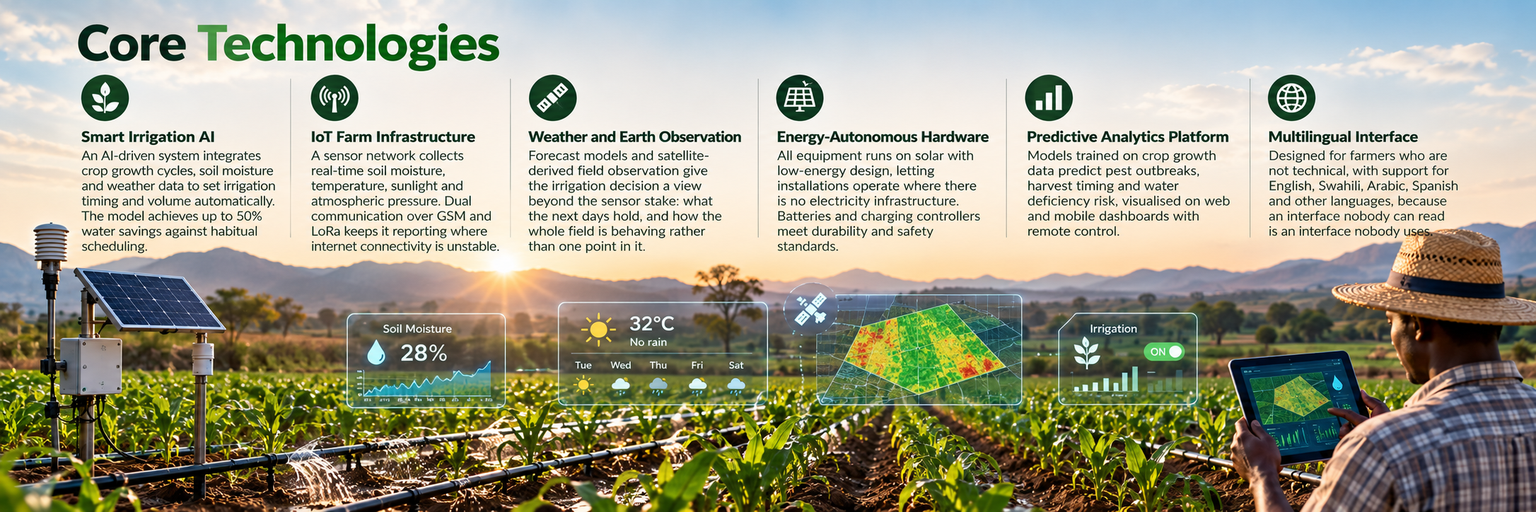
An AI-driven system integrates crop growth cycles, soil moisture and weather data to set irrigation timing and volume automatically. The model achieves up to 50% water savings against habitual scheduling.
A sensor network collects real-time soil moisture, temperature, sunlight and atmospheric pressure. Dual communication over GSM and LoRa keeps it reporting where internet connectivity is unstable.
Forecast models and satellite-derived field observation give the irrigation decision a view beyond the sensor stake: what the next days hold, and how the whole field is behaving rather than one point in it.
All equipment runs on solar with low-energy design, letting installations operate where there is no electricity infrastructure. Batteries and charging controllers meet durability and safety standards.
Models trained on crop growth data predict pest outbreaks, harvest timing and water deficiency risk, visualised on web and mobile dashboards with remote control.
Designed for farmers who are not technical, with support for English, Swahili, Arabic, Spanish and other languages, because an interface nobody can read is an interface nobody uses.
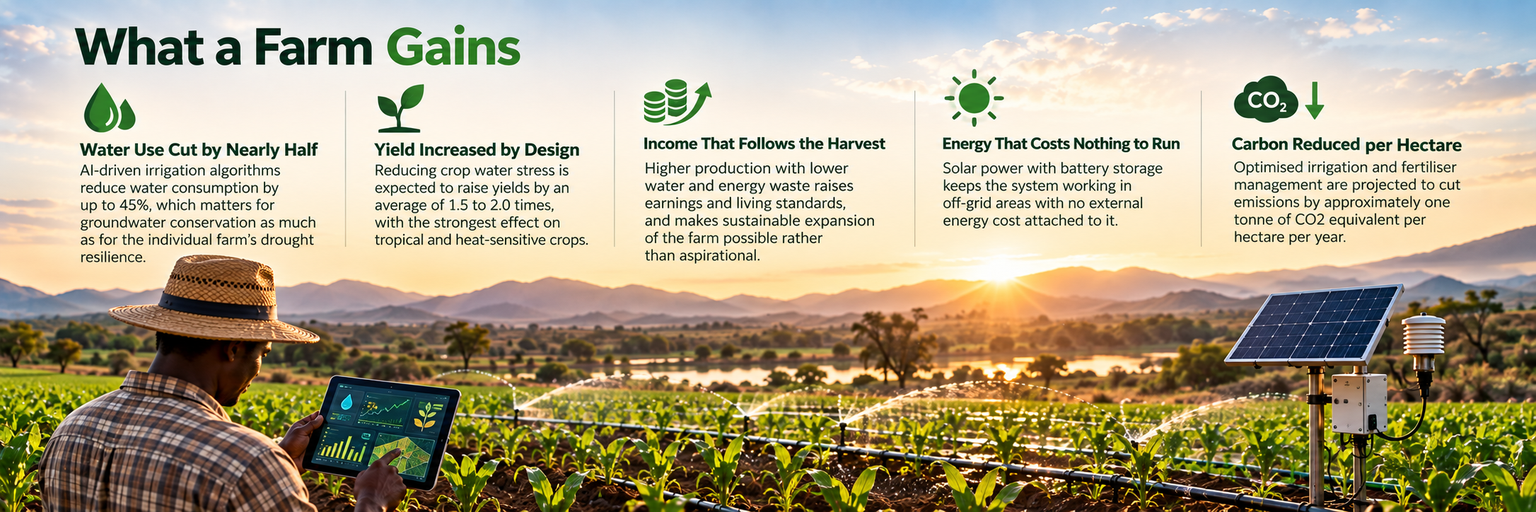
AI-driven irrigation algorithms reduce water consumption by up to 45%, which matters for groundwater conservation as much as for the individual farm's drought resilience.
Reducing crop water stress is expected to raise yields by an average of 1.5 to 2.0 times, with the strongest effect on tropical and heat-sensitive crops.
Higher production with lower water and energy waste raises earnings and living standards, and makes sustainable expansion of the farm possible rather than aspirational.
Solar power with battery storage keeps the system working in off-grid areas with no external energy cost attached to it.
Optimised irrigation and fertiliser management are projected to cut emissions by approximately one tonne of CO2 equivalent per hectare per year.
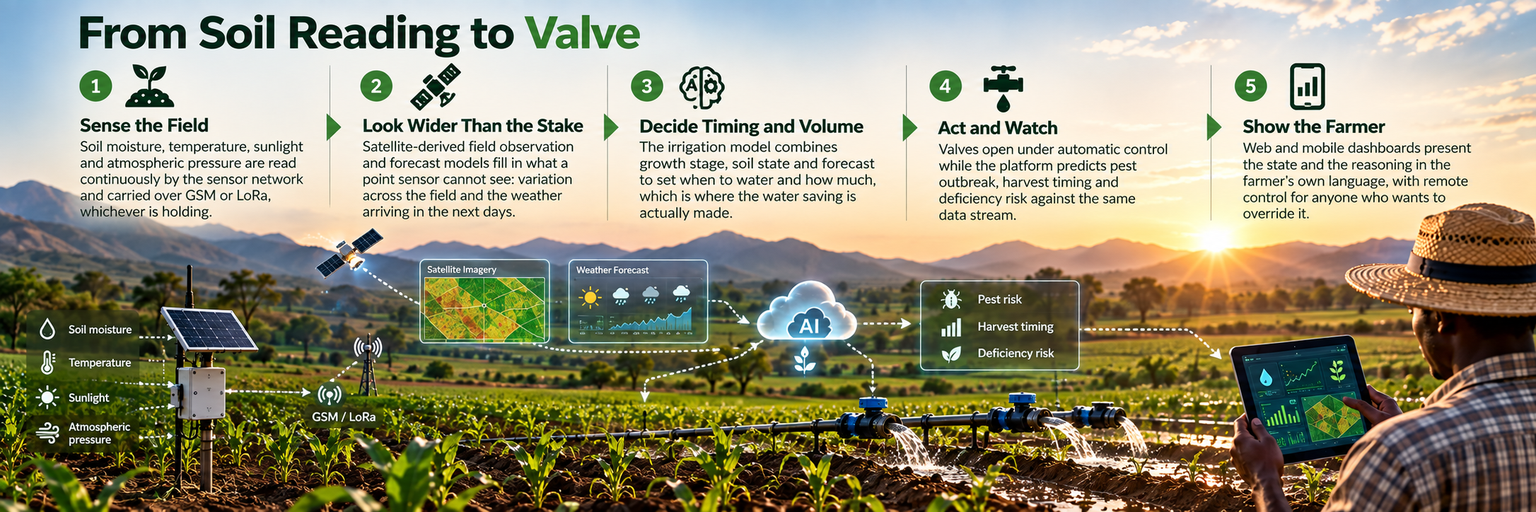
Soil moisture, temperature, sunlight and atmospheric pressure are read continuously by the sensor network and carried over GSM or LoRa, whichever is holding.
Satellite-derived field observation and forecast models fill in what a point sensor cannot see: variation across the field and the weather arriving in the next days.
The irrigation model combines growth stage, soil state and forecast to set when to water and how much, which is where the water saving is actually made.
Valves open under automatic control while the platform predicts pest outbreak, harvest timing and deficiency risk against the same data stream.
Web and mobile dashboards present the state and the reasoning in the farmer's own language, with remote control for anyone who wants to override it.
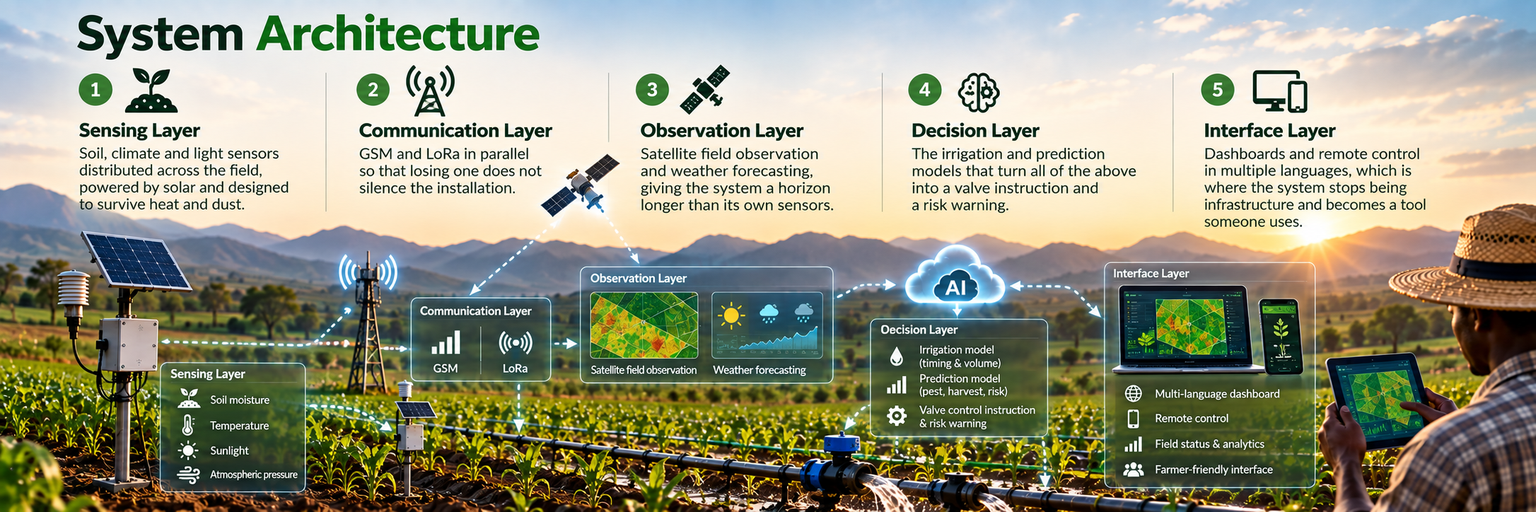
Soil, climate and light sensors distributed across the field, powered by solar and designed to survive heat and dust.
GSM and LoRa in parallel so that losing one does not silence the installation.
Satellite field observation and weather forecasting, giving the system a horizon longer than its own sensors.
The irrigation and prediction models that turn all of the above into a valve instruction and a risk warning.
Dashboards and remote control in multiple languages, which is where the system stops being infrastructure and becomes a tool someone uses.
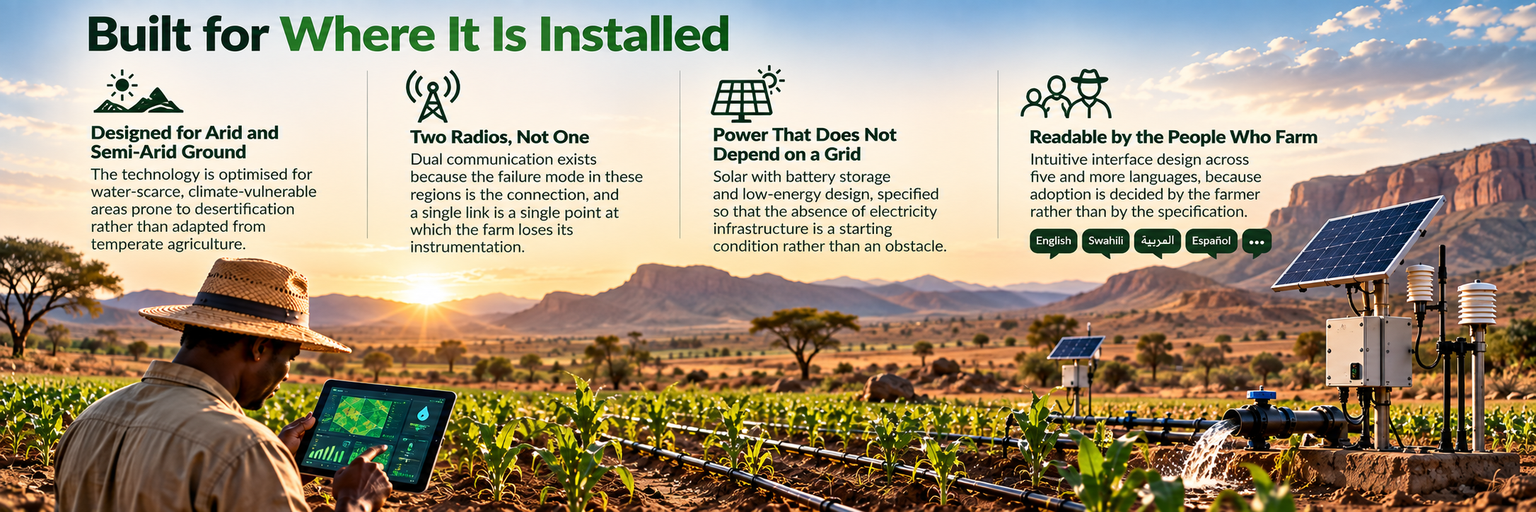
The technology is optimised for water-scarce, climate-vulnerable areas prone to desertification rather than adapted from temperate agriculture.
Dual communication exists because the failure mode in these regions is the connection, and a single link is a single point at which the farm loses its instrumentation.
Solar with battery storage and low-energy design, specified so that the absence of electricity infrastructure is a starting condition rather than an obstacle.
Intuitive interface design across five and more languages, because adoption is decided by the farmer rather than by the specification.
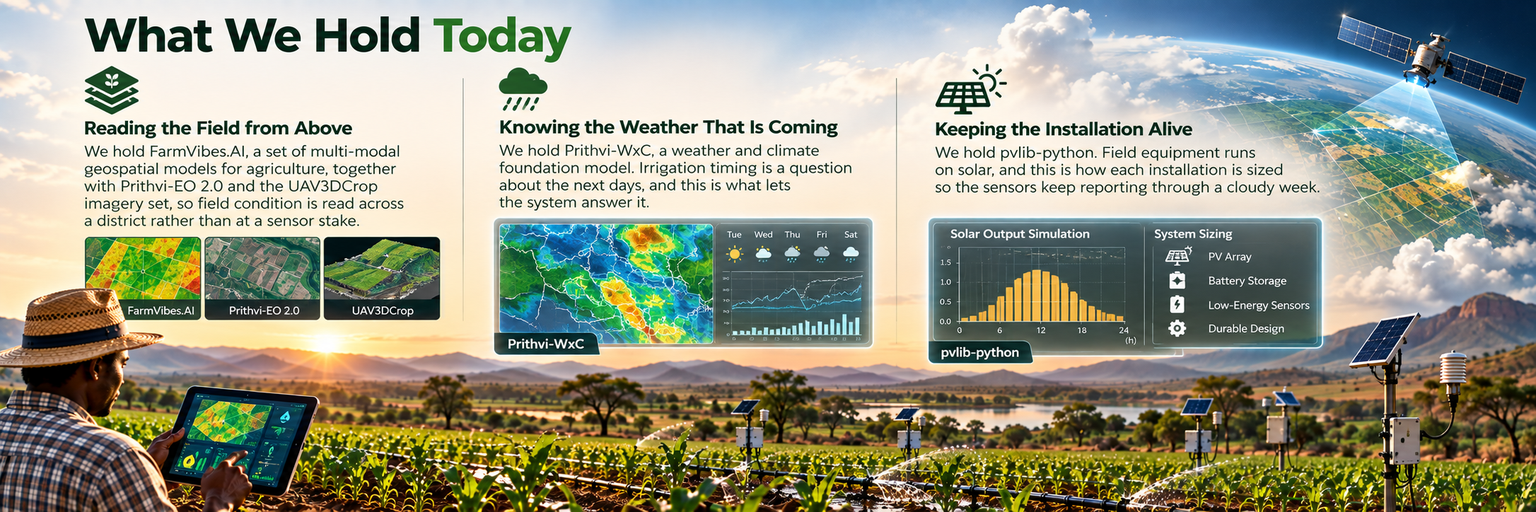
We hold FarmVibes.AI, a set of multi-modal geospatial models for agriculture, together with Prithvi-EO 2.0 and the UAV3DCrop imagery set, so field condition is read across a district rather than at a sensor stake.
We hold Prithvi-WxC, a weather and climate foundation model. Irrigation timing is a question about the next days, and this is what lets the system answer it.
We hold pvlib-python. Field equipment runs on solar, and this is how each installation is sized so the sensors keep reporting through a cloudy week.
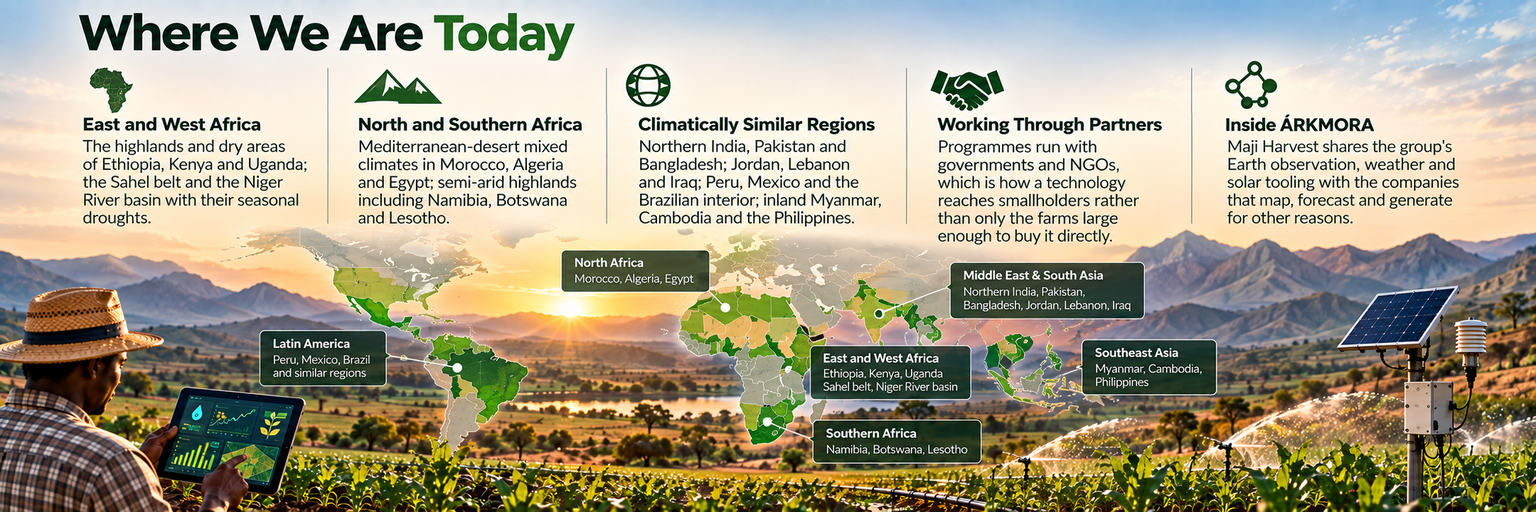
The highlands and dry areas of Ethiopia, Kenya and Uganda; the Sahel belt and the Niger River basin with their seasonal droughts.
Mediterranean-desert mixed climates in Morocco, Algeria and Egypt; semi-arid highlands including Namibia, Botswana and Lesotho.
Northern India, Pakistan and Bangladesh; Jordan, Lebanon and Iraq; Peru, Mexico and the Brazilian interior; inland Myanmar, Cambodia and the Philippines.
Programmes run with governments and NGOs, which is how a technology reaches smallholders rather than only the farms large enough to buy it directly.
Maji Harvest shares the group's Earth observation, weather and solar tooling with the companies that map, forecast and generate for other reasons.
"Water is life. Intelligence preserves it. Maji Harvest gives every farmer the tools to grow more with less."
Maji Harvest — Smart Farming for a Thirsty World.