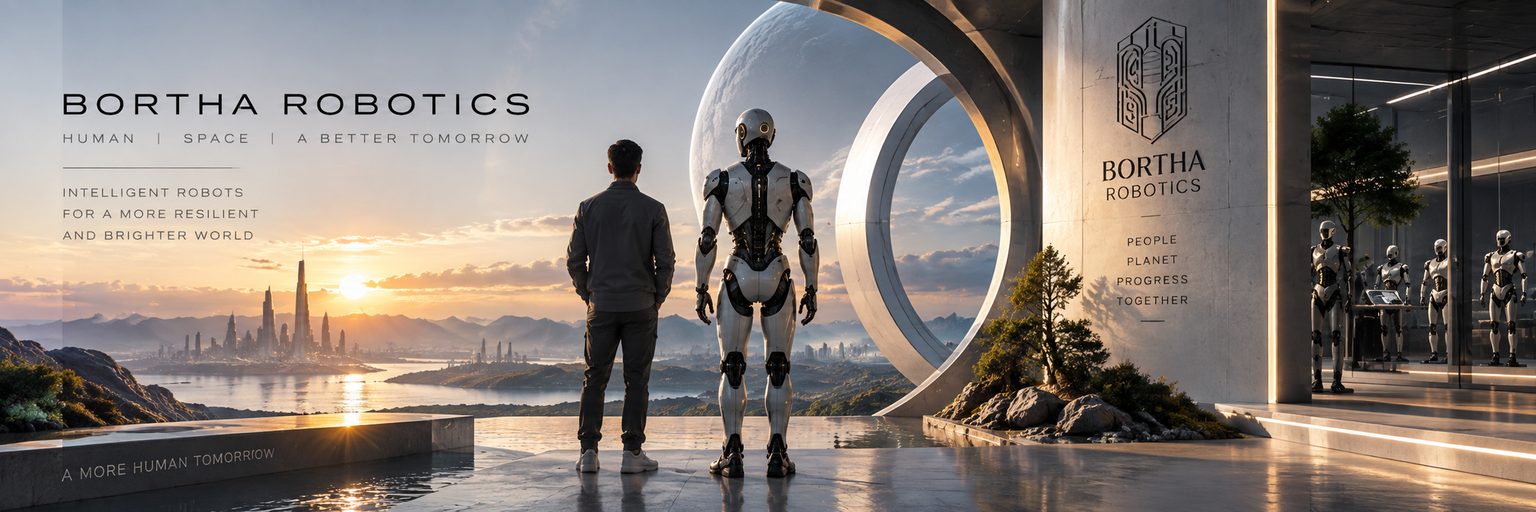
"Bortha originates from the language of ancient warriors, meaning 'iron will' and 'limitless conquering spirit'."
We fuse the philosophy of ancient civilizations with the boundless possibilities of AI engineering to lead an era where all existence is granted intelligence.
Bortha Robotics builds intelligent robotic systems that respond in real-time and autonomously adapt to their environment, leveraging NOCKË AI's distributed cognition and design simulation framework.
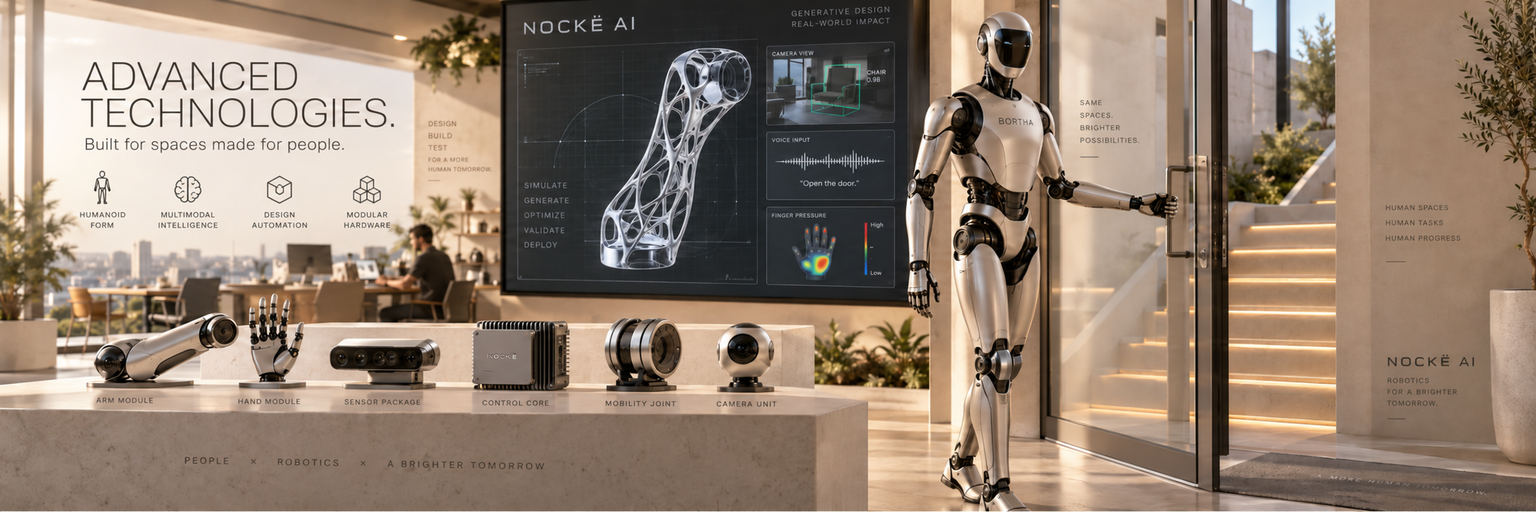
A human-shaped body works in spaces already built for people — doors, stairs, shelves and hand tools — without rebuilding the site around the robot.
Vision, voice and touch are read together, so a Bortha unit understands the request, the scene around it and the object in its hand at the same time.
Generative design and structural simulation shape each part on screen first, so every new module has already been tested in simulation before it is built.
Arm, hand, sensor package, control core, mobility joint and camera unit are separate modules on one body, so a unit can be repaired or reconfigured in the field.
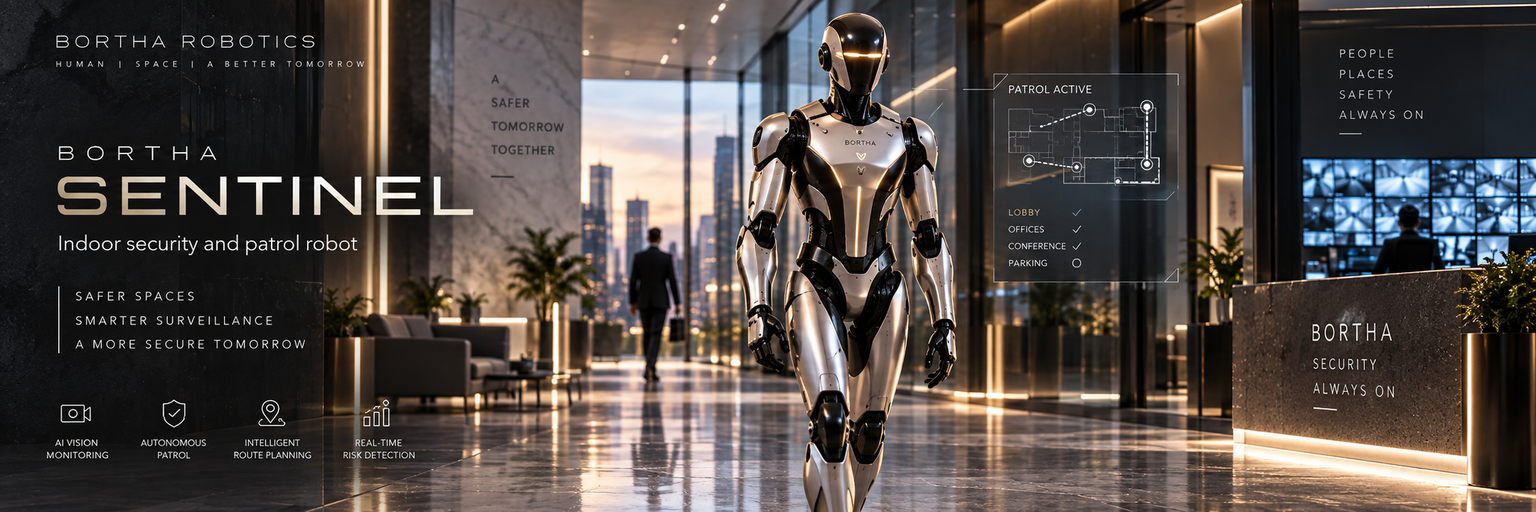
A bipedal humanoid that walks offices, lobbies, conference floors and parking levels, with whole-body balance trained in physics simulation and carried over through sim-to-real transfer.
Omnidirectional perception built on vision foundation models; segmentation picks out people, objects and unattended items in real time.
Graph- and sampling-based path planning (A*, RRT*) sets each patrol route and re-plans it around people and obstacles.
Multimodal anomaly detection fuses vision with speech recognition and audio understanding, and escalates alerts to the security desk.
Patrols run day and night on fixed or changing routes, and a shift report goes to the security desk at every handover.
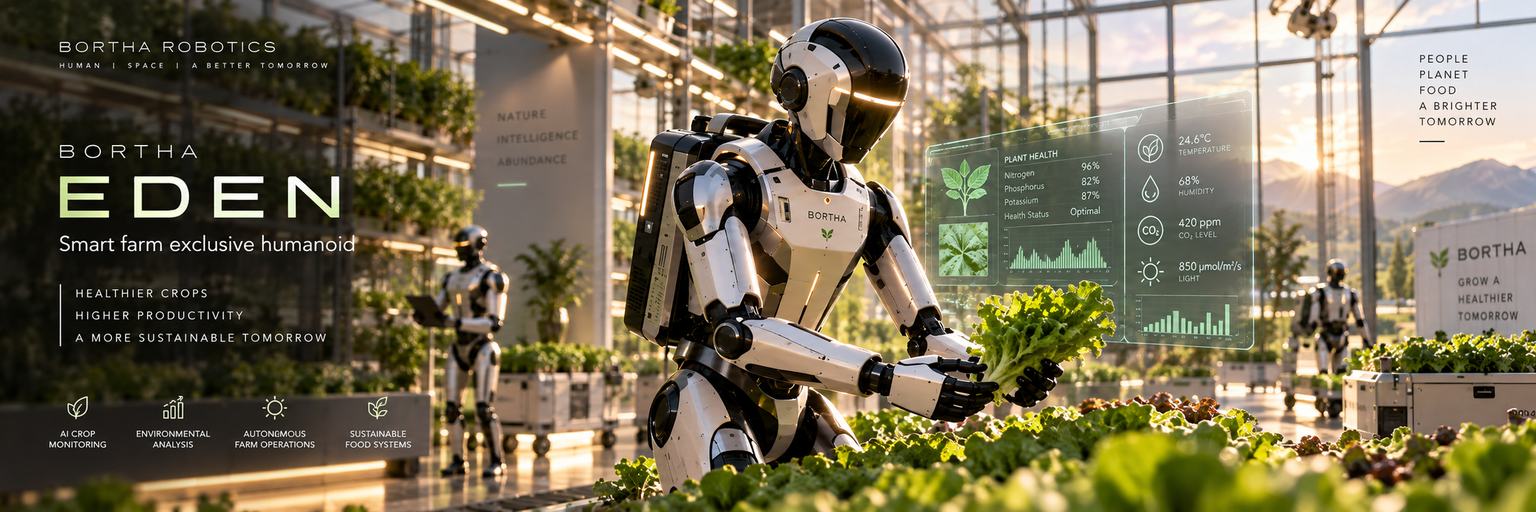
A humanoid farmhand built for greenhouses and open fields, tending and harvesting crops row by row with human-like dexterity.
Vision foundation models and plant-level segmentation read every leaf and fruit, flagging signs of stress, disease and ripeness early.
Motion planning guides each arm to pick, prune and transplant without bruising, while path planning moves it between rows.
Multi-modal geospatial models fuse weather, soil and satellite data to time irrigation, lighting and pest prevention.
Plant-by-plant care puts water, nutrients and crop protection only where each plant needs them, for healthier crops and a more sustainable tomorrow.
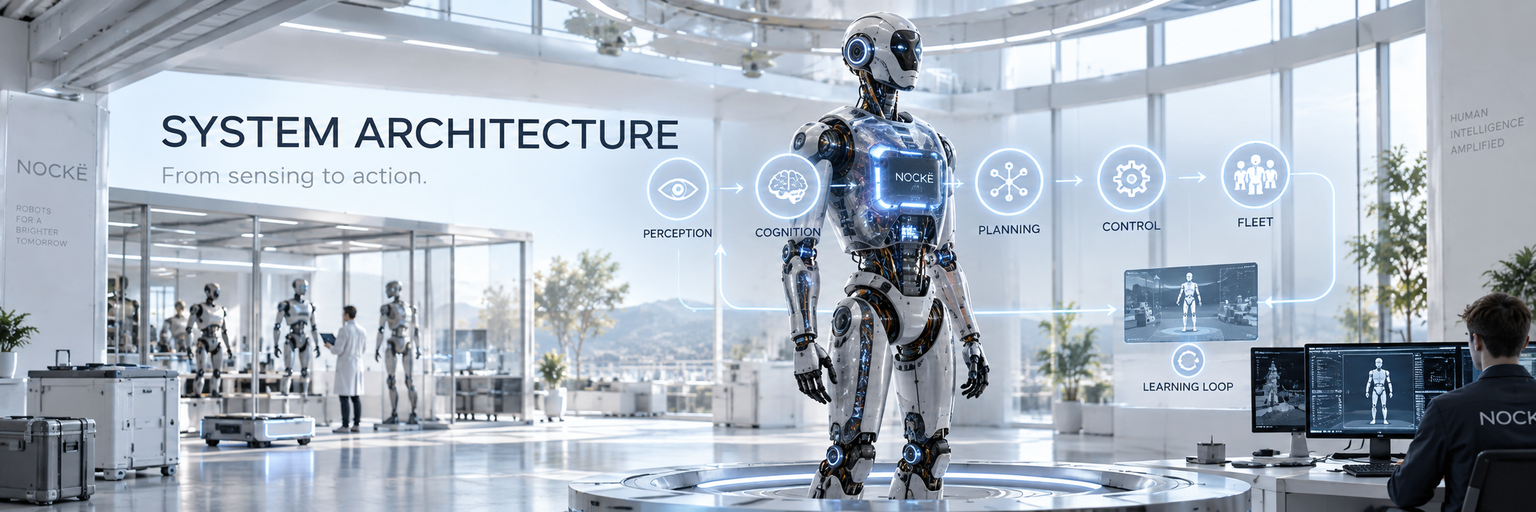
Stereo and depth cameras, an inertial measurement unit, joint encoders, force sensing in the hands and a microphone array give a continuous picture of the body and its surroundings.
Vision foundation models and language understanding turn raw sensor data into a scene — who is there, what is where, and what the task requires next.
Whole-body, arm and path planning choose each next movement, and re-plan as soon as people or obstacles move.
Joint-level controllers drive every actuator in real time, keeping the robot balanced while it walks, reaches and carries.
A fleet console assigns tasks across many units, shows their status in one view and sends software updates to each robot remotely.
Data from every shift flows back into simulation, where skills are retrained and tested before an update reaches the fleet.
Speed and force are limited whenever a person is detected nearby, and the robot slows or stops before contact.
Critical decisions are cross-checked by more than one type of sensor, such as camera and depth, so a single faulty reading cannot trigger an unsafe action.
A physical stop button on every unit and a remote stop for the operator — either one halts all motion at once.
Overcurrent cut-off and automatic shutdown when battery or motor temperature leaves its safe range.
Every sensor, joint and module is checked at power-on, and no task begins until every check passes.
Encrypted links and authenticated operators, with every command and alert logged for later review.
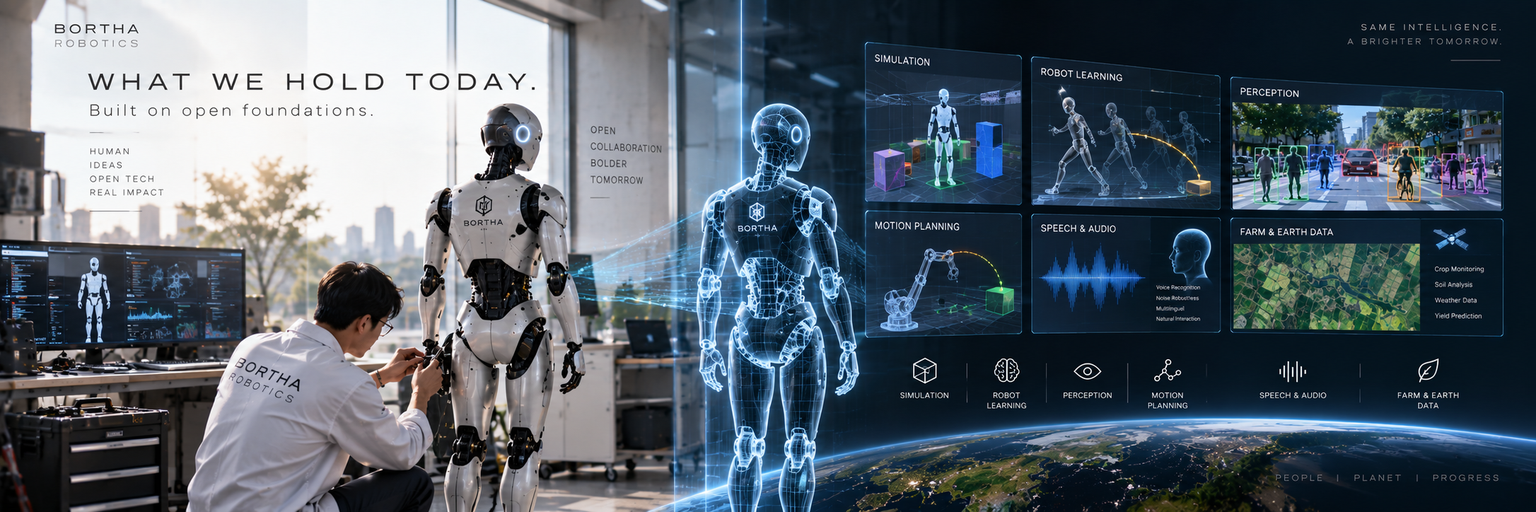
MuJoCo with the MuJoCo Menagerie robot models, Genesis and Gazebo. Balance, gait and grasping are trained and tested in physics simulation first, then carried over to real hardware.
LeRobot for datasets and training, openpi with the π0 and π0.5 vision-language-action models, and X-VLA. Skills are learned from demonstration and refined in simulation.
SAM 3 for segmentation, DINOv2 and SigLIP as vision backbones, and Florence-2 for detection and captioning — the vision foundation models behind Sentinel's monitoring and Eden's crop reading.
MoveIt 2 for arm motion planning, Fields2Cover for row-by-row coverage paths across a field, and PythonRobotics as the reference for A* and RRT* search.
Whisper large-v3 and Voxtral Mini Realtime for speech recognition, so Sentinel can hear and answer people on its route.
FarmVibes.AI and OpenWeedLocator for field data and weed detection, and Prithvi-EO 2.0 for reading satellite imagery.
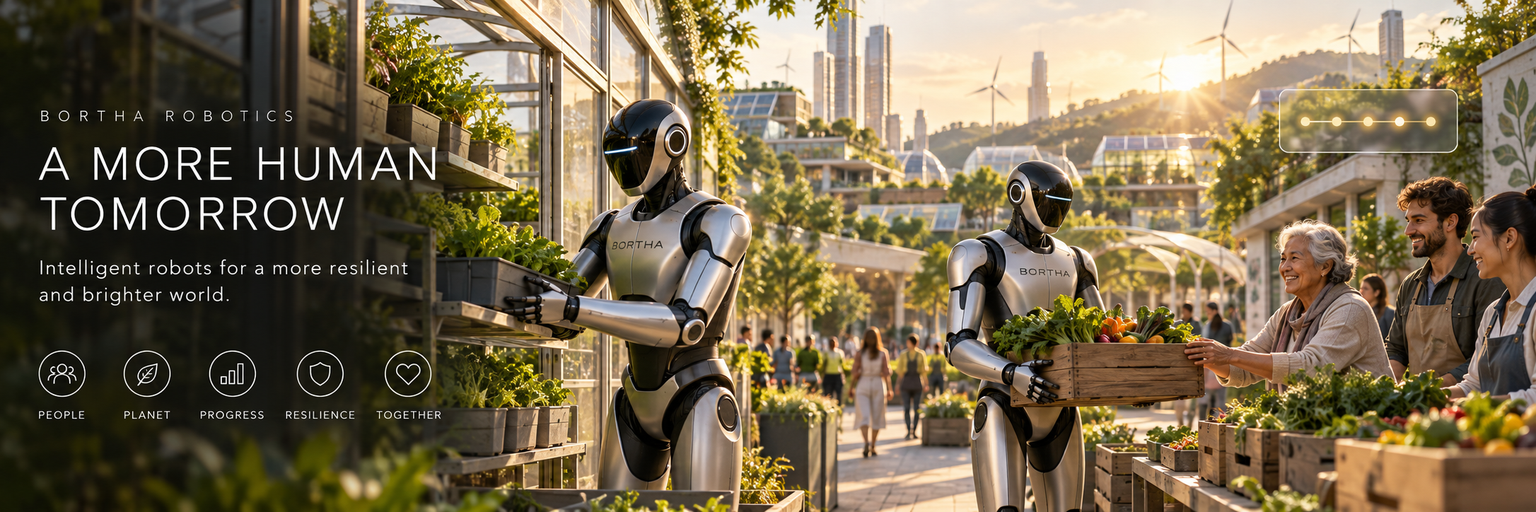
We are building toward a world where intelligent robots stand beside people, making every place more resilient, every task safer and every day more human.
Humanoids take the night shift, the heavy lift and the dangerous task, so people keep the work that needs judgement, care and a human touch.
Food grown plant by plant with less water, energy and chemicals, and buildings run by machines that waste less.
A skill learned once in simulation reaches every unit, so a farm in a remote valley gets the same capability as a flagship site next to a research lab.
Where power, networks or skilled hands are scarce, robots keep food growing and spaces safe, the very places Bortha Robotics is built to serve.
We will get there with the people who work beside our robots: prototypes first, then field trials, with results published here as they are measured.
"Intelligence is not just built — it is born. Every Bortha unit carries the iron will of an ancient warrior and the cognition of tomorrow."
Bortha Robotics — Granting Intelligence to Every Existence.